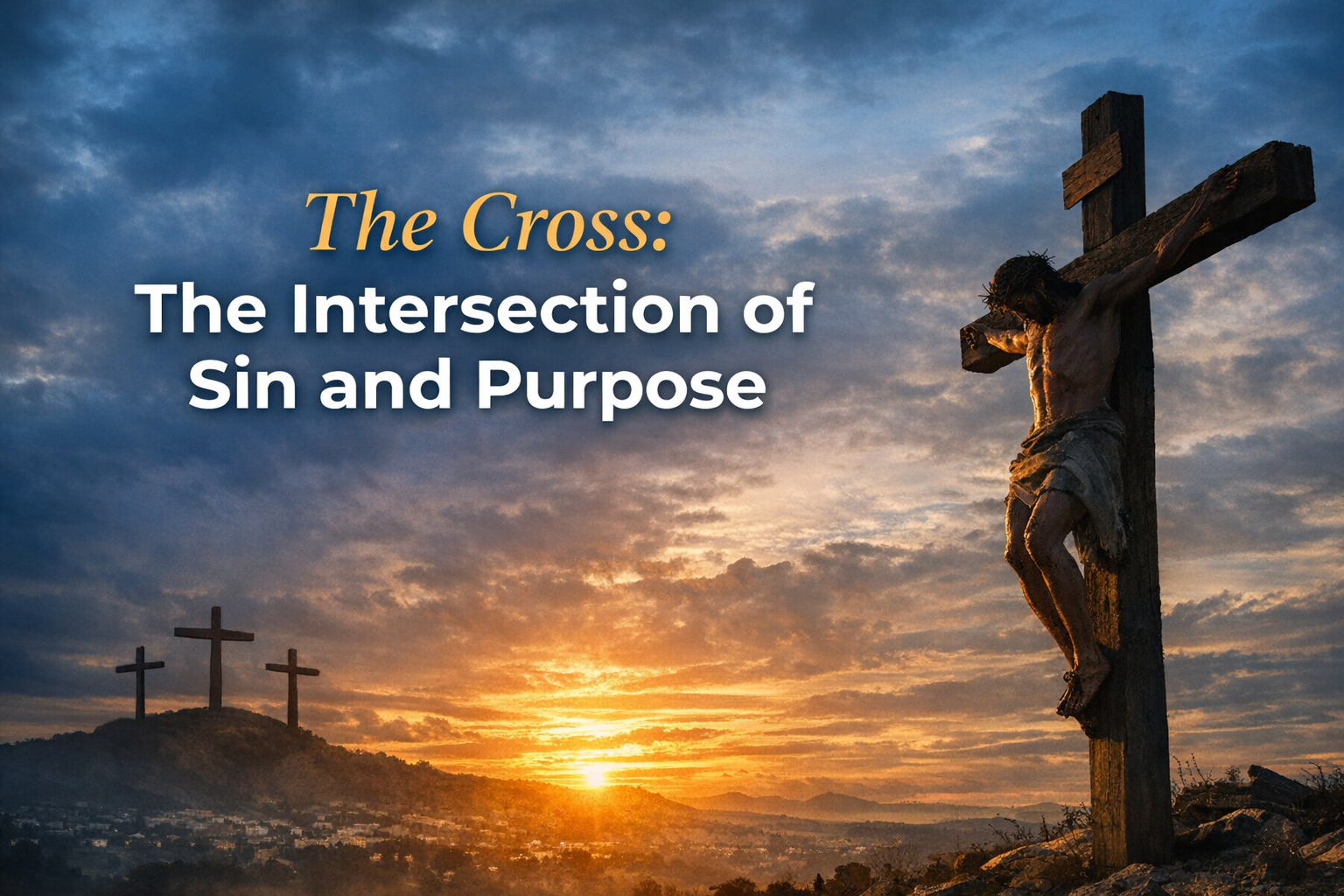
Good Friday meaning is not found merely in the suffering of Jesus, but in what His sacrifice accomplished. Judas had already decided to betray Him (Matthew 26:14–16; Mark 14:10–11; Luke 22:3–6), and what followed would reveal the meaning of the cross, the atonement of Jesus, and why Jesus died to redeem humanity and restore us to God’s purpose.
What Is the Meaning of Good Friday?
Good Friday meaning is found in the cross of Christ. It is the day Jesus willingly endured betrayal, rejection, suffering, and death so that sin could be fully atoned for and humanity could be restored to God. The cross was not only the payment for sin, but also the doorway into restored identity, redemption through Jesus, and alignment with God’s purpose.
Key Takeaways: Good Friday Meaning
- Betrayal often begins internally long before it manifests externally.
- Misalignment of identity leads to compromised decisions.
- Jesus demonstrated love independent of others’ actions.
- The cross was both a payment for sin and an invitation into purpose.
- Alignment, not circumstance, determines legacy.
Judas had already decided (Matthew 26:14–16; Mark 14:10–11; Luke 22:3–6).
That’s what makes this moment so sobering. The betrayal didn’t begin with a kiss in the garden. It began with a decision made in the hidden place of the heart. To those looking from the outside, everything appeared normal. Judas sat at the table. He walked with the disciples. He followed Jesus just like the rest (Matthew 26:20; Mark 14:17; Luke 22:14; John 13:21–30).
But inwardly, something had already shifted.
Judas had already determined to sell Jesus out—and he had already made the arrangement for thirty pieces of silver (Matthew 26:15).
This was not a random number. In the Old Testament, thirty pieces of silver was the price required if a slave was gored by an animal—the compensation paid to the slave owner (Exodus 21:32). That is the value Judas placed on Jesus’ life.
A transaction.
A valuation.
A betrayal.
And the sign of that betrayal would be a kiss (Matthew 26:48–49; Luke 22:47–48).
A kiss—something meant to communicate affection and honor—became the signal that identified Jesus to those who came to arrest Him in the dark.
Why Jesus Died: The Meaning of the Cross
When we arrive at the Last Supper, Judas is still there (Matthew 26:20; Mark 14:17; Luke 22:14; John 13:21–30). Nothing outwardly distinguishes him from the others. And yet, in one of the most striking moments in all of Scripture, Jesus kneels and washes the feet of every disciple—including Judas (John 13:1–11).
Jesus already knew (John 13:11, 18–19).
He knew what Judas had determined. He knew what had already been set in motion. And still, He washed his feet.
Not because Judas deserved it—but because love is not determined by the condition of the recipient. It flows from the nature of the One who gives it.
At the table, Jesus makes the announcement: “One of you will betray Me” (Matthew 26:21; John 13:21).
The room shifts. The question begins to move from disciple to disciple: “Is it I?” (Matthew 26:22; Mark 14:19; Luke 22:23).
John, leaning back against Jesus, asks directly, “Who is it?” (John 13:25).
Jesus responds that it is the one who dips his hand into the dish with Him (Matthew 26:23). But that doesn’t narrow it down—everyone had done that. Judas had blended in so well that no one suspected him.
Finally, Jesus looks directly at Judas and says, “What you do, do quickly” (John 13:27).
At that moment, Scripture tells us that Satan had entered him (Luke 22:3; John 13:27). Yet even then, the others still didn’t understand. They assumed Jesus was sending Judas on an errand because he handled the money (John 13:28–29). What they didn’t know—what John later reveals—is that Judas had been stealing from the money bag all along (John 12:6).
The betrayal was not sudden. It was cultivated.
And like most betrayal, it was close and personal.
Jesus’ Sacrifice Explained Through Good Friday
Jesus then goes to the garden to pray (Matthew 26:36; Mark 14:32; Luke 22:39). The weight of what is coming presses in. He asks the Father if the cup might pass—but His resolve remains: “Not My will, but Yours be done” (Luke 22:42; Matthew 26:39; Mark 14:36).
The disciples, overcome with exhaustion, cannot stay awake (Matthew 26:40–41).
And then Judas arrives—with a crowd, with weapons, with intent (Matthew 26:47; John 18:3).
He approaches Jesus and greets Him with a kiss.
In that moment, the symbol of intimacy becomes the instrument of betrayal.
And yet, even here, something remarkable happens.
When they ask if He is Jesus, He answers, “I am He”—and they all draw back and fall to the ground (John 18:4–6). In a single moment, His authority is revealed. This is not a man being overpowered. This is a Savior surrendering.
Peter reacts the way many would—he draws his sword and strikes, cutting off the ear of the servant Malchus (John 18:10; Luke 22:50). But Jesus immediately tells him to put the sword away (Matthew 26:52; John 18:11).
This would not be accomplished by force.
No one was taking His life.
He was laying it down (John 10:17–18).
And then He asks the question that echoes through the moment: “Do you betray the Son of Man with a kiss?” (Luke 22:48)
What follows is a cascade that reveals the depth of human instability.
- The disciples scatter (Matthew 26:56; Mark 14:50).
- Peter denies Him (Matthew 26:69–75; Luke 22:54–62; John 18:15–27).
- The same crowds that shouted “Hosanna” days earlier (Matthew 21:9) now cry out, “Crucify Him!” (Matthew 27:22–23).
Praise turns to accusation. Honor turns to mockery.
Jesus is beaten, ridiculed, and publicly shamed (Matthew 27:27–31). He is led to the cross and crucified (John 19:16–18). As He hangs there, He is mocked and scorned (Luke 23:35–37). In that moment, His name becomes associated with shame, and the world attempts to erase Him.
This is what betrayal produces.
And it is not unfamiliar.
Many have experienced it—being betrayed by those closest to them, misunderstood, abandoned, dismissed by people who once walked alongside them.
Jesus has been there.
He knows the pain—and He knows it fully.
How the Cross Opens the Door to Purpose
So why did He go through it?
Because of love (John 3:16; John 15:13).
Because without death, there is no resurrection (Luke 24:26).
Because He knew the end of the story.
It was always a story of redemption.
Good Friday was never the conclusion—it was the cost.
The only way sin could be paid for was through sacrifice. Jesus endured the rejection, the ridicule, the breaking of His body, the shedding of His blood, and ultimately His death (Matthew 20:28; Mark 10:45).
He did it willingly.
He did it out of love.
He did it for you.
He did it to pay a price you could never pay.
Final Reflection and Charge
So the question is not whether Jesus was betrayed.
The question is not whether He suffered.
And the question is not whether the price for sin was paid—because it was.
Fully. Completely. Once and for all.
The cross was the final atonement for sin.
Nothing left undone. Nothing left unpaid.
But it was never meant to be the end of the story.
It was the doorway.
The doorway back to the Father.
The doorway into restored identity.
The doorway into God’s true purpose for your life.
Jesus was betrayed—but He did not break.
He was rejected—but He did not retreat.
He was crucified—but He fulfilled His assignment.
And that is the pattern.
Alignment in the face of pressure.
Obedience in the presence of pain.
Purpose that does not shift with circumstance.
So here is the charge:
Do not receive the atonement and reject the alignment.
Do not accept the forgiveness and resist the transformation.
Step fully through the doorway.
Because the same cross that paid for your sin also cleared the path for your purpose.
And the question now is not what Jesus has done—it is whether you will align your life with what He finished.
The Good Friday meaning is clear: Jesus paid the full price for sin, revealed the power of the cross, and opened the way for redemption through Jesus. His death was not the end of the story, but the beginning of restored relationship, identity in Christ, and purpose in God.
Continue Exploring
If this message resonates with you, explore more from the Simplicity Church Network and Simply Organic Faith:
- Read more about the network’s mission on
Our Vision. - Explore discipleship and ministry tools in
Resources. - Learn more about simple church multiplication at
Start a Church. - Take the next step in partnership through
Join the Network. - For a deeper look at identity and restoration, read
Zechariah 3: God Silences the Accuser and Restores. - If you are walking through pain in faith communities, read
How to Rebuild Faith After Church Hurt.
Frequently Asked Questions
What is the meaning of Good Friday in Christianity?
Good Friday meaning in Christianity centers on the sacrificial death of Jesus Christ on the cross. It marks the day Jesus paid the penalty for sin, fulfilled the requirement of justice, and opened the way for redemption and reconciliation with God.
Why did Jesus have to die on the cross?
Jesus died on the cross because sin required payment, and only a spotless sacrifice could fully atone for it. His death accomplished what humanity could never do on its own: forgiveness, cleansing, and restored access to the Father.
What does the cross represent for believers?
For believers, the cross represents both the final atonement for sin and the love of God revealed through Jesus Christ. It is also the doorway into restored identity, spiritual alignment, and purpose in God.
Why is Judas’ betrayal important to the Good Friday story?
Judas’ betrayal reveals that the suffering of Jesus did not begin at the cross alone. It began with rejection from someone close. His betrayal highlights the personal cost of redemption and shows that Jesus willingly endured both relational pain and physical suffering.
How does Good Friday connect to God’s purpose for my life?
Good Friday is not only about what Jesus saved you from, but also what He saved you for. The cross removes the barrier of sin and opens the door to restored relationship, transformed identity, and alignment with God’s true purpose for your life.
What happened after Good Friday?
After Good Friday came the resurrection. Jesus’ death paid for sin, and His resurrection demonstrated victory over death, hell, and the grave. Together, they form the heart of the gospel message.