Simplicity Church Network

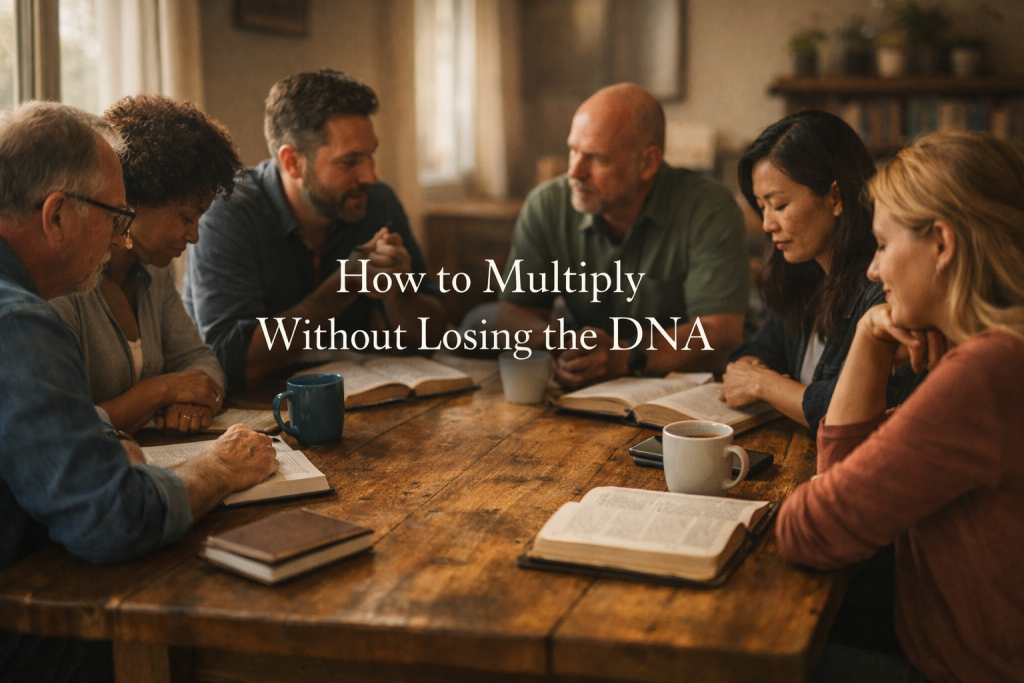
A warm, cinematic portrait of a diverse group of six adults gathered around a rustic wooden table in a softly lit room, engaged in Bible study and conversation. Open Bibles, notebooks, and coffee mugs rest on the table as natural window light casts gentle shadows across the scene. The overlaid title reads, “How to Multiply Without Losing the DNA.”
Discipleship & Multiplication

How to Multiply Without Losing Your DNA

How to Multiply Without Losing the DNA Multiplication is a gift. When disciples begin discipling others, when relational communities form organically, when renewal quietly spreads across environments — homes, workplaces, congregations, networks — something sacred is happening. Life is expanding. Faith is taking root in new soil. The Spirit is at work. But growth, if we are not attentive, can also expose what we have not yet examined. Movements rarely drift because of opposition. More often, they drift because of momentum. As influence widens, complexity increases. As complexity increases, pressure follows. And pressure has a way of revealing whether our roots run deep enough to sustain what is emerging. It is possible to expand and yet slowly lose the very essence that made the work alive. What began centered on Jesus can gradually become centered on outcomes. What began grounded in Scripture can become shaped by personality. What began prayerful can become strategic first and spiritual second. The external form may remain intact, but the interior life begins to thin. For those entrusted with leadership, the question is not merely how to multiply. It is how to steward multiplication without compromising the DNA that defines us. That is sacred work. Key Takeaways Multiplication reveals the depth of our formation. DNA is spiritual essence, not structural format. We reproduce what we embody, not merely what we teach. Expansion must never outrun spiritual depth. What we celebrate quietly shapes our culture. Leaders are to be recognized by fruit, not created by urgency. Alignment is preserved through shared submission to Jesus and Scripture. Multiplication is fruit of faithfulness, not the mission itself. Expression Changes. Essence Cannot. Across the New Testament, the people of God gathered in varied ways — in homes, in temple courts, in marketplaces, by riversides, in rented halls. The structure adapted to context. The confession did not. The apostles did not defend a model. They guarded the gospel. For us, the same distinction must remain clear. Relational expressions of community may take many forms. Some are intimate gatherings around a table. Some form in business environments. Some bring renewal within established congregations. Some emerge through networks of disciple-makers across regions. The container may differ. But the center must remain fixed. Spiritual DNA is not about format. It is about what sits at the heart: Jesus as Lord. Scripture as final authority. The Spirit actively leading. Obedience flowing from encounter. Love shaping community life. Leaders formed in humility. Belonging that creates space for transformation. If these remain intact, diversity of expression strengthens the work. If these shift, even the most faithful-looking structure cannot preserve what matters most. The church has always been called to guard the treasure entrusted to it. That guarding is not defensive — it is faithful. The Pattern of Drift in Scripture Drift is not new. It is visible within the pages of the New Testament itself. The churches in Galatia began in the Spirit but were gradually drawn toward performance. Paul’s question still echoes: “Having begun by the Spirit, are you now being perfected by the flesh?” The issue was not activity; it was dependence. In Corinth, factions formed around leaders. Allegiance shifted subtly from Christ to personalities. The gatherings continued. The gifts operated. But the center wavered. In Ephesus, perseverance and doctrinal clarity remained strong, yet they were warned that they had left their first love. Orthodoxy persisted. Affection thinned. In each case, there was no immediate collapse. There was no sudden abandonment of faith. There was simply a gradual shift in what occupied the center. Multiplication magnifies whatever sits at the center. If Christ remains central, growth deepens worship and humility. If performance or personality becomes central, growth deepens pressure and division. Drift is rarely dramatic. It is incremental. That is why vigilance must be gentle but constant. We Multiply Our Interior Life When Paul instructed Timothy to entrust what he had received to faithful people who would teach others also, he described multiplication across generations. But the emphasis was not merely on transmission of content. It was on the character of those entrusted. Faithful. Leaders reproduce more than ideas. They reproduce posture. Those who walk closely with us are learning: How we respond to disagreement. Whether we confess weakness. Whether Scripture truly governs our decisions. Whether prayer shapes direction or simply blesses it. Whether humility is practiced or merely preached. If we lead from insecurity, insecurity will echo outward.If we lead from ambition, ambition will ripple outward.If we lead from surrendered dependence, that too will multiply. Multiplication does not create character. It reveals it. For this reason, theological depth and identity rooted in grace are not optional. Leaders secure in Christ do not need growth to validate them. They do not need visibility to sustain them. Their stability protects the environment around them. Depth Before Width There is always a temptation in seasons of growth to move quickly. Opportunities increase. Invitations multiply. Leadership demands expand. Yet Scripture consistently ties fruitfulness to abiding. Jesus did not equate impact with acceleration. He equated it with remaining in Him. Formation precedes sending. If expansion outpaces formation, pressure will eventually expose the imbalance. When criticism arises or conflict surfaces, shallow roots struggle. Leaders without deep formation instinctively reach for control or performance. Leaders who have been shaped in prayer and Scripture reach for patience and discernment. Growth is not the problem. Growth without depth is. As stewards, we must resist expanding beyond the depth of our formation. Culture Forms Around What We Honor In every movement, certain stories rise to the surface. What we celebrate communicates what we value. If scale consistently receives affirmation, scale becomes the pursuit. If influence is subtly admired, influence becomes the aspiration. If rapid expansion is equated with faithfulness, patience begins to feel like weakness. But if we consistently honor quiet obedience, costly faithfulness, reconciliation, generosity, and humility under pressure, a different culture forms. The kingdom grows like seed in soil — often unseen before it is visible. Multiplication must remain fruit.

Wide-angle cinematic dawn landscape of a solitary figure standing on a rugged cliff overlooking a mist-covered valley, golden sunlight breaking through dark clouds. Subtle glowing embers burn near the cliff edge. In the sky, elegant serif title text reads “What God Is Doing in the Gaps” with the subtitle “The Slow Burn of Kingdom Formation.”
Apostolic Journey & Desolate Places

What God Is Doing in Your Waiting Season

The Slow Burn of Kingdom Formation I. Introduction: The Fear of the Gap The invitations slow. The momentum stalls. The door that seemed certain closes without explanation. Your influence feels smaller.Your voice feels quieter.Your progress feels delayed. And the whisper rises: Did I miss God? Leaders are addicted to movement. We measure fruit by expansion.We measure obedience by visibility.We measure calling by acceleration. But here is the truth most leaders resist: The gap is not where God pauses your calling — it is where He purifies it. Delay is not divine hesitation.It is divine refinement. What feels like loss is often reduction for strength.What feels like silence is often surgical precision. If you are in a gap, you are not abandoned. You are being rebuilt. Key Takeaways Hiddenness is not punishment — it is preparation. God deepens before He displays. Reduction precedes authority. Waiting exposes false dependencies. Fast growth produces fragile leaders. Slow burn produces immovable ones. If God has slowed you down, He is increasing your weight. II. The Lie of Immediate Momentum The modern church worships speed. We assume that if God is in it, it will expand quickly. That is not Kingdom thinking. Jesus was hidden for 30 years. David was hunted before he was crowned. Joseph was imprisoned before he governed nations. God builds leaders the way He builds foundations — underground first. Silence does not mean stagnation. Silence means excavation. Waiting is not weakness. Waiting is warfare against impatience. If you cannot endure obscurity, you cannot steward influence. III. The Pattern You Cannot Escape Every Kingdom assignment follows a pattern: Promise Hiddenness Testing Reduction Release You do not skip hiddenness. You do not bypass testing. You do not negotiate reduction. The leader who tries to outrun this process collapses under the weight of what they prayed for. Hiddenness is not interruption. It is initiation. IV. Elijah: Detox Before Fire Elijah confronted kings. Then God sent him to a brook. Alone.Dependent.Reduced. The brook dried up. That was not failure. That was detox. God was stripping Elijah of visible strength so that heaven could trust him with visible power. Then came Carmel. Fire from heaven did not come from charisma. It came from hidden dependence. And when Elijah collapsed in the cave? God did not scold him. God recalibrated him. If you are in a cave, God is not punishing you. He is purifying your identity. V. Jeremiah: Obedience Without Applause Jeremiah preached. They ignored him. He warned. They resisted. He wept. Nothing changed. Would you stay if revival never came? Would you obey if fruit never surfaced? Jeremiah’s success was not measured in crowds. It was measured in faithfulness. The gap does not guarantee applause. It guarantees exposure of your motives. VI. Discern the Gap Not all slow seasons are equal. The Consequence Gap God is correcting you.Conviction is sharp.Exposure is mercy. The Formation Gap God is strengthening you.Intimacy increases.Clarity deepens. The Transition Gap God is repositioning you.Old grace lifts.New direction is forming. Discernment matters. But in all three, one thing is certain: God is not inactive. VII. What God Is Actually Doing He is purifying your motives. He is breaking your addiction to validation. He is strengthening internal structure. He is removing the need to be seen. He is increasing your spiritual weight. Authority in the Kingdom is not granted by position. It is forged in surrender. The gap reveals what you were leaning on. And God will remove whatever competes with Him. VIII. The Slow Burn vs. The Flash Fire Flash fire: Rapid growth Shallow roots Loud influence Fragile leaders Slow burn: Deep roots Quiet strength Durable authority Leaders who cannot be shaken The world celebrates flash. Heaven builds slow burn. If God has slowed you down, He is protecting you from premature exposure. IX. How to Lead in the Gap Do not manufacture momentum. Do not scramble for relevance. Do not chase platforms. Abide. Listen. Obey the small things. Write down what God says. Refuse to move until He moves you. Isolation will distort you — stay connected to trusted voices. And above all, surrender fully. Half-surrender prolongs formation. Full surrender stabilizes it. Leadership Reflection Ask the Lord: What ambition are You removing? What dependency are You exposing? What identity are You dismantling? What strength are You building? Sit until the answer unsettles you. That is where formation begins. X. The Promise of the Slow Burn You are not behind. You are under construction. God is not withholding promotion. He is building capacity. He is not silencing you. He is sharpening you. He is not shrinking your influence. He is strengthening your core. The gap is not empty. It is holy ground. Hidden seasons produce leaders who cannot be manipulated, intimidated, or destroyed. The fire that lasts is rarely lit quickly. But when it burns, it does not go out. FAQs How long will this gap last? As long as it takes for the internal structure to match the external assignment. Can I accelerate the process? Only through surrender. Resistance prolongs it. Obedience stabilizes it. How do I know if this is formation and not failure? Failure drives you from God. Formation drives you into Him. Should I make major moves during this season? Not unless the Lord speaks clearly. Gaps are for rooting, not scrambling. Why does this feel like loss? Because something is dying. And what dies in you makes room for what must live through you. What is the greatest danger in the gap? Premature movement. Grasping for visibility. Forcing what God is still forming.

A solitary leader stands on a hillside overlooking a softly glowing city at dawn or dusk, under a wide sky with warm light breaking through clouds. The scene feels calm and contemplative, with large centered text reading, “Why Burnout Isn’t Inevitable for Missional Leaders.”
Leadership & Soul Care

Why Burnout Isn’t Inevitable for Missional Leaders

🔥 Burnout Is Not the Price of Obedience Most missional leaders don’t burn out because they stopped loving God. They burn out because they loved people deeply… and quietly stopped listening to their own soul. Burnout rarely shows up as rebellion.It shows up as faithfulness without limits. It looks like: answering one more text late at night because “they really need me” skipping rest because “this season is critical” absorbing conflict without processing it carrying responsibility God never verbally assigned And somewhere along the way, exhaustion gets baptized. “This is just the cost of obedience.”“This is what it means to pour yourself out.” But Scripture never teaches that obedience requires the erosion of the soul. Jesus carried the weight of the world’s redemption.He faced relentless need, unending crowds, constant misunderstanding, spiritual warfare, betrayal, and the shadow of the cross. And yet—He never burned out. He was fully present.Deeply obedient.Utterly surrendered. But never frantic.Never hollowed out.Never driven by guilt or fear. Which forces an uncomfortable question for every missional leader: If Jesus never burned out, why have we normalized it as inevitable? ✅ Key Takeaways (Read These Slowly) Burnout is not proof of faithfulness; it is often evidence of misplaced responsibility. Urgency does not equal obedience—Jesus routinely disengaged from real need. Most burnout is fueled by false inner vows, not external pressure. Sustainable mission flows from abiding, not overextension. God never intended leaders to carry the mission alone. 🧱 The Quiet Beliefs That Drain Missional Leaders Burnout is rarely caused by workload alone.It is fed by beliefs we never stop to examine. 1. “If I don’t do it, it won’t get done.” This belief usually forms honestly. You stepped in when no one else would.You carried things others dropped.You proved reliable. And eventually, responsibility turned into identity. “If I step back, things fall apart.” But Scripture has a name for this. When Moses carried Israel alone—leading, judging, solving, absorbing—God did not commend his sacrifice. He confronted it. “What you are doing is not good… You will surely wear yourself out.”(Exodus 18:17–18) Burnout often isn’t the result of too much obedience.It’s the result of taking ownership of outcomes God never assigned to you. Faithfulness does not require omnipresence. 2. “The needs are too urgent to rest.” This belief feels spiritual.It sounds compassionate.It feels responsible. But it is not how Jesus lived. Picture the moment:Crowds pressing in.The sick waiting.Disciples overwhelmed. And Jesus… withdraws. “But Jesus often withdrew to lonely places and prayed.”(Luke 5:16) This wasn’t avoidance.It was alignment. Jesus understood something missional leaders forget: Meeting every need is not the same as obeying the Father. Urgency does not lead the Kingdom.The Spirit does. 3. “Burnout is just the cost of being faithful.” Sacrifice is biblical.Self-neglect is not. God commanded Sabbath before Israel entered the Promised Land—not as a luxury, but as a declaration: “You are not slaves anymore.” “In returning and rest you shall be saved;in quietness and trust shall be your strength.”(Isaiah 30:15) When leaders confuse hustle with holiness, burnout is not heroic—it is predictable. 🌱 The Jesus Pattern: Leadership From Overflow, Not Overreach Jesus did not organize His days around need. He organized His life around listening. “The Son can do nothing by Himself;He can do only what He sees His Father doing.”(John 5:19) That single sentence dismantles most modern leadership models. Jesus healed many—but not all.He taught crowds—but invested in a few.He walked away from opportunity when the Father said no. He could disappoint people without violating obedience. Burnout is often the fruit of compassion disconnected from discernment. Jesus loved fully—but He listened first. 🔄 The Rhythms That Keep Leaders Alive These are not productivity hacks.They are survival rhythms forged under pressure. 1. Abiding Before Doing Abiding is not sermon prep.It is not strategic prayer. It is the daily re-centering of identity. “Apart from Me you can do nothing.”(John 15:5) Most leaders don’t drift because they stop believing.They drift because they stop being still long enough to remember who they are before they lead. 2. Soul-Level Relationships Many leaders have meetings.Few have mirrors. Scripture assumes leaders will confess, be known, and be held. “Carry each other’s burdens…”(Galatians 6:2) Isolation is not strength.It is the soil burnout grows in. 3. Sabbath as Resistance Sabbath is an act of defiance. It says: God can move without me The world will not collapse if I stop My worth is not my output Burnout often reveals a truth we resist: There is a burden you were never meant to carry alone. 4. Shared Leadership, Not Lone Shepherding Jesus empowered others.He released authority.He trusted the Spirit at work beyond Himself. If everything depends on you, something is wrong. 🌊 What Obedience Without Burnout Actually Looks Like It looks like leaders who are: fruitful but not frantic rested but not disengaged honest about limits quick to repent of false responsibility able to say yes without resentment and no without guilt These leaders don’t quit the mission. They outlast it. 🛠 Tools That Support Long-Term Faithfulness Not solutions—supports. Resilient Shepherd Manual – for leaders carrying long-term weight Recharge & Renewal Guides – for burned or burning leaders Weekly soul check-ins that ask “How are you?” before “What’s next?” Tools don’t replace the Spirit.They simply protect space to listen. 🔚 Final Word: You’re Not Called to Burn Out You are called to burn bright. Jesus does not measure faithfulness by exhaustion.He measures it by obedience rooted in love. “Come to Me, all who are weary and burdened,and I will give you rest.”(Matthew 11:28) Your soul matters more to God than your output.Always has.Always will. Lead from the secret place.Let go of what was never yours to carry.And trust that God does not need your exhaustion to accomplish His will. ❓ FAQs (Because Leaders Ask These Quietly) Isn’t burnout inevitable if you really care?No. Caring deeply requires better boundaries, not weaker ones. What if people suffer when I slow down?You are responsible for obedience, not outcomes. Is rest selfish when the mission is urgent?No. Rest is trust in

Person walking toward a cross at sunrise with an open Bible; title reads “Disciple First: Why Discipleship Can’t Be Reduced to Models.”
Discipleship & Multiplication

Disciple First: Why Discipleship Can’t Be Reduced to Models

Disciple First, Organize Second: The 2026 Reset Re-centering Ministry Planning Around People, Not Programming Introduction: Why 2026 Requires a Reset Across churches, networks, and ministries, a quiet realization is surfacing:we are more organized than ever—and less formed than we hoped. Calendars are full. Systems are polished. Strategies are optimized.And yet many leaders sense the same tension—people are attending, serving, and participating, but not necessarily becoming disciples in the way Jesus envisioned. This is not a failure of effort or sincerity. Most ministry leaders are working harder than ever. It is, however, a failure of order. Over time, ministry has subtly shifted from discipleship producing structure to structure attempting to produce discipleship. What began as support became substitution. Organization moved from servant to centerpiece. The 2026 Reset is not a rejection of leadership, planning, or structure. It is a reordering—a return to the sequence modeled by Jesus Himself: Disciple first. Organize second. Key Takeaways (At a Glance) Scripture establishes discipleship as the foundation, not the outcome Jesus formed people before building systems The early church organized only in response to disciple-making Discipleship is relational before it is reproducible Leadership exists to equip, not control Organization is healthiest when it emerges from lived formation The Biblical Order We Lost—and Must Recover The call to disciple first is not a reaction to modern church fatigue. It is a biblical pattern. Jesus’ ministry does not begin with structure or strategy. It begins with calling. In Matthew 4:18–22, Jesus calls fishermen to follow Him before offering explanation or instruction.In Mark 3:13–15, the purpose of the Twelve is unmistakable: “He appointed twelve that they might be with Him, and that He might send them out…” Presence precedes mission. Relationship comes before responsibility. Before naming apostles in Luke 6:12–13, Jesus spends the night in prayer. And in John 15:4–8, He establishes the governing order of fruitfulness: “Abide in Me… and you will bear much fruit. Apart from Me you can do nothing.” Discipleship is not an output of organization. It is the soil from which everything else grows. The Drift: How We Reversed the Order Without Noticing Drift rarely begins in rebellion. It begins in efficiency. As ministries grow, systems are added to support people. Over time, people are shaped to support systems. Discipleship becomes assumed rather than cultivated. The symptoms appear quietly: Attendance replaces obedience as a primary metric Scripture becomes content rather than formation Participation is mistaken for transformation Leaders manage activity more than they shepherd lives Paul names this reversal directly: “Having begun by the Spirit, are you now being perfected by the flesh?” (Galatians 3:3) When discipleship becomes procedural, the Spirit is quietly replaced with management. Disciple First: The Way of Jesus Defined by Scripture Biblically, discipleship is not information transfer. It is formation through shared life under Scripture. Jesus’ pattern is consistent: With Him – presence (Mark 3:14) Like Him – formation (Luke 6:40) Sent by Him – obedience (Matthew 28:19–20) Scripture is not an accessory in this process—it is the shaping agent. As Isaiah 55:10–11 reminds us, God’s Word accomplishes what He intends when it is allowed to work deeply rather than quickly. Discipleship that begins anywhere else eventually collapses under the weight of expectations it was never meant to carry. Simplicity 3.0: Rooted in the New Testament Church Simplicity 3.0 is not a new idea. It is a return to New Testament clarity. In Acts 2:42–47, the church is formed around devotion—to Scripture, fellowship, prayer, and shared life. Growth follows, but it is not engineered. Only later, in Acts 6:1–7, does organization appear—and it appears in response to discipleship already happening, not as a substitute for it. This establishes a crucial principle: In Scripture, structure emerges to protect formation—not replace it. The Five On-Ramps: Biblical Postures, Not Modern Categories People have always approached Jesus from different places. The spiritually wounded find restoration (John 21) The curious ask questions in the dark (John 3) The disillusioned process disappointment on the road (Luke 24) The apathetic are warned and invited (Revelation 3) The isolated are called back into shared life (Hebrews 10) Jesus never demanded uniformity before relationship. He walked patiently with people where they were, allowing Scripture and encounter to do the work. Discipleship that forgets this patience inevitably becomes transactional. Organize Second: The Scriptural Role of Structure Scripture affirms organization—but always as a servant. In Acts 6, structure is introduced to preserve unity and protect spiritual focus.In 1 Corinthians 14:40, order exists to serve edification, not efficiency. Before building anything, leaders must ask:Who is this discipling—and how? When that question is unclear, structure has already moved out of place. Why Discipleship Resists Models The modern church is not lacking discipleship models.If anything, we are drowning in them. Every year brings new frameworks, pathways, and best practices—each promising clarity, scalability, and reproducible outcomes. Most are well-intentioned. Many are thoughtful. Some even bear short-term fruit. The issue is not that models are evil.The issue is that discipleship does not belong to the same category as models. Discipleship is not a mechanism to be optimized. It is a relational reality that must be discerned and stewarded in dependence on the Spirit. Jesus never offered a standardized pathway. He offered Himself. He speaks differently to Nicodemus (John 3) than to the rich young ruler (Mark 10). He restores Peter with questions, not instructions (John 21). He walks confused disciples through Scripture before revealing Himself (Luke 24). Models assume control. Discipleship requires surrender.Models aim for repeatability. Discipleship demands attentiveness. Even Jesus says: “The Son can do nothing by Himself; He can do only what He sees His Father doing” (John 5:19). The early church reflects this same posture. In Acts 16, the Spirit actively prevents Paul from executing what would have appeared to be wise ministry plans. Paul issues a sober warning: “Such regulations indeed have an appearance of wisdom… but they lack any value in restraining the flesh” (Colossians 2:23). The 2026 Reset is not a call to find a better model.It is

Missional team praying around an open Bible beside a table, with a tree showing deep roots in the background, symbolizing Spirit-led, rooted, and reproducible leadership.
Apostolic Journey & Desolate Places

How Missional Teams Stay Rooted, Reproducible, and Spirit-Led

Introduction: Why Missional Teams Are Burning Out—and How to Build Differently Across the global Church and marketplace mission field, a pattern has become impossible to ignore. Teams are launching fast, carrying genuine vision, and seeing early fruit—yet many are quietly unraveling beneath the surface. Burnout is normalized. Fragmentation is common. Leaders feel pressure to sustain momentum without losing their souls or their people. The problem is not a lack of passion, gifting, or opportunity.The problem is formation. Too many missional teams are built on personality, programs, or pressure rather than on Spirit-led rhythms. When urgency replaces discernment and productivity replaces presence, even well-intentioned Kingdom efforts begin to drift. What starts as obedience slowly becomes maintenance. What begins in faith quietly shifts into force. As we move into 2026, the Spirit is not calling leaders to do more, but to build deeper. Teams that endure and multiply will not be the loudest or the most resourced—they will be the most rooted, the most relationally healthy, and the most reproducible. This article explores three essential rhythms that must be intentionally cultivated if missional teams are to remain faithful, fruitful, and Spirit-led for the long haul. Key Takeaways Presence precedes power—and power pursued without presence often mutates into control. Teams rarely collapse from lack of gifting; they collapse from unaddressed drift. Relational fracture is seldom sudden; it is usually tolerated tension over time. Reproducibility is not merely a strategy—it is a sign of spiritual maturity. Irreplaceable leaders create fragile movements. The Spirit must be trusted not only for empowerment, but for direction. What a team normalizes in its culture will eventually multiply through its mission. Rhythmic Leadership vs. Reactionary Leadership One of the clearest dividing lines between teams that endure and teams that implode is the difference between rhythmic leadership and reactionary leadership. Reactionary leadership is driven by urgency. Decisions are made in response to pressure, needs, or opportunities without space for discernment. The team is always responding, always adjusting, always busy—yet rarely still. Over time, this pace dulls spiritual sensitivity, strains relationships, and exhausts leaders. Rhythmic leadership is different. It is anchored in intentional spiritual pace. It recognizes that the Kingdom advances through obedience, not adrenaline. Leaders who live rhythmically are not passive; they are attentive—to God, to people, and to timing. Jesus modeled this consistently. He withdrew to pray. He resisted being rushed by crowds. He moved with clarity because He lived from communion with the Father. That pace produced fruit that remained. Missional teams shaped by rhythmic leadership learn to ask a different question. Not “What needs to be done next?” but “What is the Spirit saying now?” That shift quietly reorders everything. Rhythm One: The Rhythm of Abiding Staying Rooted in God’s Presence Every sustainable missional movement begins here. Abiding is not a private spiritual luxury; it is a corporate necessity. Jesus’ words are unambiguous: “Apart from Me you can do nothing” (John 15:5). Teams may remain active for a season, but disconnected from the Vine they lose the capacity to bear lasting fruit. For a missional team, abiding means more than individual devotional discipline. It is a shared commitment to prayer, Scripture, worship, and listening together. It means leaders modeling intimacy with God rather than substituting activity for dependence. It means making space for repentance and restoration—because “He restores my soul” (Psalm 23:3) is not poetry; it is survival. Practically, teams that abide pray before they plan, listen before they launch, and allow Scripture to govern decisions rather than merely support vision. Worship becomes alignment, not atmosphere. Silence becomes as valuable as strategy. Drift warning: when a team loses abiding, it replaces dependence with drive—and spiritual authority with spiritual exhaustion. Team Practice (next 7 days):Schedule one unhurried, agenda-free team prayer time focused solely on listening and Scripture—not planning or problem-solving. Rhythm Two: The Rhythm of Relating Staying Healthy, Honest, and Aligned Together No missional team collapses suddenly. They fracture relationally long before they fail publicly. The early church “devoted themselves” to shared life (Acts 2:42). Unity was practiced, not presumed. Scripture also names the danger clearly: “Encourage one another daily… so that none of you may be hardened” (Hebrews 3:13). Hardness forms where truth is delayed. The longer a team exists, the more relational health becomes decisive. Unaddressed offense leaks into mission. Hidden resentment distorts communication. Avoided conversations eventually sabotage discernment. The rhythm of relating requires intentional practices: confession without fear, encouragement without manipulation, and alignment without control. It requires leaders who are approachable, not insulated—and teams willing to “speak the truth in love” (Ephesians 4:15) rather than spiritualize avoidance. Healthy teams address tension early, before it calcifies. They refuse to sacrifice truth for false peace. They understand that unity is not the absence of disagreement, but the presence of trust. Drift warning: when relating breaks down, teams often compensate with structure or intensity—trying to organize what only humility and repentance can heal. Team Practice (next 7 days):Create intentional space for one honest relational check-in where team members can name tension, fatigue, or misalignment without correction or defense. Rhythm Three: The Rhythm of Releasing Staying Reproducible and Spirit-Multiplied Reproducibility is not primarily a growth strategy—it is a discipleship issue. Paul’s instruction is straightforward: entrust what you’ve received to faithful people who can teach others (2 Timothy 2:2). This is not optional for movements; it is the pattern. Missional teams that endure are not built around irreplaceable leaders. They are built around transferable rhythms. Authority is shared. Responsibility is distributed. Jesus did not build a ministry dependent on His physical presence; He trained, entrusted, and released. The rhythm of releasing means training people to hear God, not merely execute instructions. It means delegating authority, not just tasks. It means celebrating multiplication even when it costs comfort, control, or familiarity. Drift warning: teams that refuse to release eventually become bottlenecked, personality-driven, and fragile—no matter how successful they appear. A team that releases without formation creates chaos. A team that refuses to release creates stagnation. Wisdom is found in Spirit-led

A lone figure stands on a rocky overlook at sunrise, facing a vast desert landscape, with the text “When Vision Feels Delayed: Leading Well in the Waiting” overlaid.
Apostolic Journey & Desolate Places

When Vision Feels Delayed: Leading in the Waiting

When Vision Feels Delayed: Leading in the Waiting An Apostolic Journey Through Desolate Places Introduction: Living Between Promise and Fulfillment There is a particular ache leaders experience when God has spoken clearly, yet life seems painfully quiet. You remember the moment. The calling was undeniable. The vision was not self-generated—it was received. You stepped forward in obedience with expectation and faith. And then, slowly, momentum faded. Doors didn’t open. Progress stalled. What once felt imminent now feels distant. This is not the struggle of unbelief.It is the struggle of waiting. Scripture is remarkably honest about this tension. Abraham was promised a son yet waited decades to hold Isaac. Joseph carried dreams of leadership while sitting in a prison cell. Israel stood at the edge of promise but wandered for forty years before entering it. The Bible does not treat this space between promise and fulfillment as accidental or cruel. God treats it as formative. The waiting is not God stepping away from your calling.It is God pressing deeper into it. Key Takeaways Before going further, let these truths anchor your heart in Scripture: Vision delayed is not vision denied (Habakkuk 2:2–3).Hidden seasons are God-ordained seasons (Matthew 6:6).Preparation precedes authority (Luke 16:10).Waiting still requires obedience (Hebrews 10:36).God’s timing protects both the vision and the vessel (Proverbs 19:21). These are not motivational ideas. They are biblical realities. The Pattern God Repeats With His Leaders When Scripture is read honestly, one pattern becomes unavoidable: God almost never releases leaders immediately after calling them. Moses encountered God in fire, yet returned to obscurity before confronting Pharaoh. David was anointed king but spent years in fields and caves while Saul still occupied the throne. Paul’s dramatic conversion was followed by seasons of hidden formation. Even Jesus, the Son of God, lived thirty years in quiet obedience before stepping into visible authority. This is not divine hesitation.It is divine wisdom. God is not impressed by readiness for visibility. He is committed to readiness for responsibility. Apostolic authority cannot be sustained on gifting alone—it must be anchored in character forged where no one is watching. “Humble yourselves, therefore, under God’s mighty hand, that He may lift you up in due time.” (1 Peter 5:6) A Story From the Scriptures: Joseph and the Long Middle Joseph’s story captures the ache of delayed vision with painful clarity. As a young man, he received dreams that spoke unmistakably of leadership and influence. Yet almost immediately, his circumstances moved in the opposite direction. Betrayed by family. Sold into slavery. Faithful in obscurity. Then imprisoned unjustly. Years passed. Silence lingered. Nothing in Joseph’s daily reality looked like fulfillment. And yet Scripture is clear: “The Lord was with Joseph.” Not when the dream came true—but in the prison, in the waiting, in the long middle between promise and promotion. Joseph did not stop leading because his environment changed. He led in Potiphar’s house. He led in prison. He stewarded responsibility wherever God placed him. When the moment of release finally came, the weight of authority did not crush him—because the years of waiting had prepared him. God often fulfills vision suddenly, but He prepares leaders slowly. Why God Uses Desolate Places Desolate places are where God removes what cannot survive the weight of calling. In Scripture, wilderness seasons are not empty spaces. They are refining spaces. They strip away distraction, confront identity, and expose motive. Titles mean nothing there. Applause disappears. What remains is the heart laid bare before God. “The Lord led you all the way in the wilderness… to humble and test you in order to know what was in your heart.” (Deuteronomy 8:2) This is why desolate places are central to apostolic formation. God delays promotion until ambition has died and surrender has taken its place. He shapes leaders who want His will more than His validation. Desolate Places and the DNA of Simplicity Within the Simplicity movement, Desolate Places are not seen as unfortunate detours but as essential pathways of formation. This apostolic DNA recognizes that God often withdraws leaders from institutional momentum, public platforms, and visible success in order to rebuild them from the inside out. Simplicity was not birthed from strategy or expansion—it emerged from obedience, pruning, and seasons where nothing looked impressive. Desolate places produce leaders who are: Not driven by platforms Not sustained by systems Not dependent on recognition But anchored in calling, obedience, and intimacy with God This is why Simplicity emphasizes presence over programs, calling over careers, and faithfulness over scale. Leaders shaped in desolate places carry authority without striving because they have already died to the need for control. Leading When Nothing Seems to Be Happening Waiting seasons do not suspend leadership—they redefine it. Leading in waiting looks like faithfulness without recognition, obedience without clarity, and service without expansion. It looks like Joseph stewarding a prison faithfully, David refusing to seize a throne prematurely, and Jesus submitting to obscurity without resentment. Scripture is clear: authority flows from faithfulness, not opportunity. “Whoever can be trusted with very little can also be trusted with much.” (Luke 16:10) In waiting, God is not asking, Can you lead crowds?He is asking, Can you lead yourself? The Hidden Danger of Delay The greatest threat in waiting seasons is not external opposition—it is internal erosion. Delay can quietly produce bitterness, comparison, cynicism, or spiritual withdrawal if the heart is left untended. Scripture repeatedly warns leaders to guard their hearts because everything flows from them (Proverbs 4:23). This is why waiting seasons demand spiritual disciplines—not as religious routines, but as lifelines. Silence, Scripture, prayer, and honest community preserve tenderness when circumstances grow hard. God is not only shaping your future assignment.He is preserving your soul. Trusting God’s Timing Without Releasing the Vision Most leaders trust God’s power. Fewer trust His pace. Yet Scripture reminds us that God’s purposes always prevail over human plans (Proverbs 19:21). Delay is often mercy. God aligns calling with capacity, authority with humility, and influence with obedience. Waiting does not mean releasing vision.It means

A wide-angle photograph of a city at sunrise with golden light breaking through clouds. In the foreground, a small group of people stand quietly on a hilltop, some with heads bowed or hands lifted in prayer, symbolizing intercession and corporate fasting for regional awakening. Text overlay reads: “How to Lead a Corporate Fast That Awakens a Region.
Apostolic Journey & Desolate Places

Lead a Corporate Fast That Awakens Your Region

How to Lead a Corporate Fast That Awakens a Region Fasting Is More Than a Personal Discipline As January unfolds, many churches and ministries around the world commit to fasting. For most, the goal is inward: spiritual renewal, clarity, or breakthrough. These are good reasons. But if that’s all we pursue, we risk missing one of the most powerful dimensions of fasting. What if your fast could shake more than your schedule or soul? What if it could shift your city? Fasting, when led in alignment with the Spirit, has the power to awaken regions. It tills the spiritual soil of neighborhoods. It confronts strongholds in cities. It builds holy hunger in a generation dulled by distraction. This kind of fasting isn’t loud. It’s not flashy. But it is catalytic. “Fasting is not about earning power. It’s about clearing space for God’s power to move through you.” Key Takeaways Corporate fasting can shift spiritual atmospheres over entire cities and regions—not just individuals. Effective fasts begin with spiritual burden, not branding or scheduling convenience. Simple, Spirit-led structures allow people to engage more deeply without distraction. Fasting should include intercession for the region, not just the local church or team. End your fast with commissioning, launching participants into action and spiritual obedience. The goal isn’t performance but alignment—with the purposes of God for your region. 1. Rediscover the Biblical Pattern for Regional Fasting Throughout Scripture, fasting is often corporate—and regional. It was the response of entire cities, nations, and leadership networks when divine intervention was needed. In Jonah 3, the people of Nineveh fasted from the king down to the animals. It wasn’t just personal repentance—it was societal surrender. In Ezra 8, leaders fasted for protection on their return to Jerusalem, acknowledging their dependence on God in uncertain terrain. In Esther 4, a fast was called not just for personal clarity but to confront a spiritual plot of genocide. Biblical fasting often preceded breakthrough. Not just for one person, but for entire communities. This is the legacy we inherit. And it is the call we carry. Fasting isn’t just a devotional tool. It’s a spiritual weapon. 2. Start With Burden, Not Branding Too many fasts begin as events instead of encounters. A true corporate fast doesn’t begin in the planning room—it begins in the prayer room. Ask yourself: What is God burdening your heart for in this region? What spiritual walls do you sense need to fall? Where are people stuck in cycles that need to break? Fasts that flow from burden carry a different authority. They carry the weight of Heaven. You don’t need to rally people with clever themes if the Spirit has already gripped their hearts. This is not about spiritual branding. It’s about alignment. 3. Build a Simple, Spirit-Led Framework Once the burden is clear, build a framework that helps people engage with God. Keep it simple. Keep it sacred. Set a clear start and end date. Offer options for how people can participate (like a Daniel fast, one meal per day, or a media fast). Include a few anchor Scriptures, a weekly prayer theme, and optional prompts or reflection questions. Host one or two prayer gatherings—not to hype but to host the presence of God together. Some of the most powerful moments will likely happen in small rooms, not big events. “People don’t need hype. They need hunger.” You are not organizing a program. You are stewarding a prophetic act. 4. Widen the Scope Beyond Your Own Ministry Even if your church or house church is the only one officially fasting, make room for regional intercession. Each week, include prayer points that target more than your own group: Unity among churches in your area Spiritual awakening in the next generation Exposure of injustice, apathy, or hidden strongholds Fresh outpouring across neighborhoods or city centers Revival in rural, overlooked, or spiritually dry places The goal isn’t to control the region—it’s to contend for it. Your prayers don’t stop at your door. They reach the soil beneath your feet. 5. End With Commissioning, Not Just Celebration Don’t let the last day of your fast feel like a finish line. Let it be a holy commissioning. What has God revealed? What is He calling your people to walk out? Gather them not just to celebrate answered prayers but to commit to the next step. Invite testimonies, release prophetic words, and send out teams to pray in key locations in your region—whether that’s schools, hospitals, city hall, or neighborhoods in need. Let your fast end the same way it began: not with strategy, but with surrender. “The region won’t shift because we skipped meals. It will shift because we came into agreement with Heaven.” Leading Fasts That Cultivate Movement If you sense God is calling your house, network, or team into a fast this January, don’t settle for a spiritual detox. Ask for a spiritual downpour. Fasting is one of the clearest ways to return to the Lord’s heart and recover His strategy. It’s where burdens become vision. It’s where unity is forged. And it’s where regions begin to stir. “Blow the trumpet in Zion, declare a holy fast… then the Lord will be jealous for His land and take pity on His people.” (Joel 2:15,18) Let the fast be more than inward. Let it be intercessory. Let it be more than spiritual discipline. Let it be spiritual warfare. Let it be more than your team. Let it be for your territory. When the people fasted, the ground shifted. FAQs Q1: Does a regional fast have to be 21 days?No. Length matters less than obedience. Some fasts are 3 days, others 40. Start with what God leads and what your community can carry with integrity. Q2: What if only a few people join me?God often starts with a remnant. Your obedience can break ground for others. Even two or three gathered in His name have authority. Q3: Can I do this with house churches or a marketplace ministry?Absolutely. This kind

A wide-angle aerial view of a city at sunrise with soft golden light and a faint compass design overlay, symbolizing spiritual vision, intercession, and regional prayer focus for 2026.
Apostolic Journey & Desolate Places

7 Questions to Pray Over Your Region for 2026

Why Pray These Questions Over a Region? As we begin a new year, we must resist the urge to rush into strategy and instead return to spirit-led discernment. Every city, town, and region has a spiritual atmosphere—a unique mix of hunger, resistance, history, and destiny. As intercessors and apostolic voices, we are not called to casually occupy a place. We are called to discern, intercede, and build in alignment with Heaven. These 7 questions are not just for your quiet time. They are a blueprint for intercession and apostolic discernment as we step into 2026. They will help you: Sense the true state of your region Partner with what God is already doing Confront what needs to be broken Align with Heaven’s vision for your territory “The future of a region is shaped in the unseen realm long before it’s seen in public.” Key Takeaways Regions have spiritual climates that can be discerned. We are called to see beyond the surface and pray with prophetic clarity. Every region has strongholds that must be spiritually confronted. Intercessors break ground in prayer before leaders build on it in the natural. There is always ground ready for harvest. Ask the Spirit to show you where people are soft to the Gospel. Hidden laborers are being prepared. We must intercede for and call forth those who carry Kingdom assignments. God has a redemptive destiny for every city. His plans must be declared and contended for in prayer. The Church often faces targeted resistance. Pray for pastors and congregations to walk in unity, boldness, and purity. God wants to do something new in your region in 2026. Ask for vision beyond what you’ve seen before—and prepare to participate. 1. Lord, what is the current spiritual atmosphere over this region? Is the region marked by hunger or apathy? Spiritual openness or resistance? Fear or faith? God invites us to see beneath the surface and discern the climate of the heart. Scripture: “We wrestle not against flesh and blood, but against principalities…” (Ephesians 6:12) Prayer: Ask for the gift of discernment. Declare clarity over confusion and spiritual insight over surface-level assumptions. 2. What strongholds need to be dismantled or confronted? Every region has spiritual and cultural strongholds—patterns of sin, fear, division, addiction, idolatry, or pride. These must be identified and confronted through prayer, proclamation, and faithful presence. Scripture: “The weapons of our warfare are not carnal but mighty through God to the pulling down of strongholds…” (2 Corinthians 10:4–5) Prayer: Ask the Lord to expose cycles of bondage. Declare that old structures will be uprooted and that truth will tear down lies. 3. Where is the ground already prepared for harvest? Sometimes we overlook ripe fields because we expect harvest to look a certain way. Look for spiritually open people, communities of peace, and relationships that are already soft to the Gospel. Scripture: “Lift up your eyes… the fields are ripe for harvest.” (John 4:35) Prayer: Thank God for prepared soil. Ask to be positioned for harvest in the places He has already tilled. 4. Who are the hidden laborers You are raising up here? God often hides His future leaders in obscurity. Pray for the indigenous voices, young revivalists, unassuming servants, and overlooked laborers that He is equipping in the shadows. Scripture: “Pray to the Lord of the harvest to send out workers into His harvest field.” (Matthew 9:38) Prayer: Call forth the hidden ones. Pray for their equipping, boldness, and divine connections. 5. What is Your prophetic destiny for this region? Every place has a redemptive destiny. Ask the Lord to show you what He originally intended for your region—before sin, systems, or strongholds tried to define it. Scripture: “For I know the plans I have for you… plans to give you a future and a hope.” (Jeremiah 29:11) Prayer: Ask for prophetic vision. Declare alignment with Heaven’s assignment over your city, county, or territory. 6. What strongholds or assignments are targeting the church in this region? The enemy always attacks the gatekeepers. Is your region’s church battling disunity, spiritual weariness, religious tradition, or distraction? Ask God to reveal what the Body is facing. Scripture: “Strike the shepherd, and the sheep will scatter…” (Zechariah 13:7) Prayer: Pray for purity, unity, and resilience among pastors, leaders, and church families. Declare that the true Church will arise in power and integrity. 7. What do You want to do here in 2026 that hasn’t happened yet? This is a question of faith. Invite God to speak what’s never been seen before. Contend for the new thing He desires to birth—revival, repentance, restoration, or Kingdom movement. Scripture: “Behold, I am doing a new thing; now it springs forth, do you not perceive it?” (Isaiah 43:19) Prayer: Ask for vision beyond history. Pray for eyes to see and faith to move with God into new ground. How to Use These Questions Practically Personal Prayer Retreats: Walk and pray these over your city block by block. Corporate Intercession: Use these questions in a small group or church-wide prayer night. Planning Retreats: Start your leadership year with these before setting strategies. Fasting Season: Let these shape your January consecration fast. “What you see in the Spirit becomes what you steward on the ground.” As you step into the first weeks of 2026, don’t just ask what you want to do for God. Ask what He wants to do where you’ve been sent. Pray these questions. Write what you hear. Then move forward in faith. FAQs Q1: Who are these questions intended for?These are designed for anyone with a burden to pray for their city, town, region, or territory—especially apostolic leaders, intercessors, planters, and disciple-makers. Q2: Can I pray these alone or with a group?Both! They can be used during personal prayer walks or journaling time, as well as in team settings, fasting retreats, or corporate intercession. Q3: What if I don’t have answers to every question?That’s okay. These questions aren’t a test. They are meant to spark dialogue with God and

A wide-angle view of a peaceful garden at sunrise with soft golden light, blooming flowers, and a woman walking slowly on a stone path holding a journal, symbolizing spiritual cultivation and rest.
Discipleship & Multiplication

Becoming a Cultivator of Souls: A Guide for Women of Faith

Becoming a Cultivator of Souls A Different Kind of Growth As the calendar turns and the world rushes into resolutions, women of the Kingdom are invited to something slower—and deeper. You don’t need to prove yourself with hustle or performance. God is not waiting for you to catch up. He’s inviting you to root down. In the Kingdom, the most lasting fruit comes from hidden soil. As Psalm 1 reminds us, “[She] is like a tree planted by streams of water, which yields its fruit in season.” You don’t have to strain to produce. You only have to stay planted. You’re not called to hustle. You’re called to cultivate. You are already loved. You are already called. You are already fruitful when you abide. Key Takeaways God is more interested in your roots than your results.Lasting fruit grows from a soul rooted in Christ, not in performance. Cultivation begins in the quiet, hidden places.You don’t need a platform or title to be spiritually impactful—only obedience. Presence is more powerful than productivity.Rhythms of stillness, prayer, and rest create space for the Spirit to work. You are already loved, already called, already fruitful.Your worth is rooted in abiding, not achieving. Discipling others starts by tending to your own soul.Healthy leaders cultivate what they’ve first let God plant in them. Small, consistent rhythms lead to long-term transformation.Daily choices like Scripture meditation or encouragement are seeds of lasting fruit. What It Means to Be a Cultivator of Souls 1. You Prioritize Presence Over Performance In Luke 10:38–42, Mary sat at Jesus’ feet while Martha was distracted by serving. Jesus affirmed Mary’s choice—not because serving was wrong, but because intimacy must come before activity. Cultivators resist the pressure to prove themselves. They choose abiding over striving, remembering Jesus’ words: “Apart from Me you can do nothing” (John 15:5). 2. You Listen Before You Lead Proverbs 3:5–6 calls us to trust the Lord with all our heart and not lean on our own understanding. Cultivators slow down long enough to discern the Spirit’s voice. They let God set the pace. They believe that obedience flows best from listening, not urgency. 3. You Tend to Your Own Heart First Proverbs 4:23 says, “Above all else, guard your heart, for everything you do flows from it.” Before God uses you to cultivate others, He invites you to let Him till your own soil—removing weeds of comparison, pride, and fear so healthy growth can emerge. The Process of Cultivation: Slow, Sacred, Strategic Slowness Is Not Laziness Spiritual formation cannot be rushed. Growth that lasts is always slow on purpose. Jesus Himself compared the Kingdom to seeds that grow quietly while no one is watching. God is never late. He is patient—strengthening roots so the plant can withstand future storms. “You will be like a well-watered garden, like a spring whose waters never fail.” (Isaiah 58:11) Rhythms, Not Routines Cultivators walk with God in rhythm, not religious routine. Think of rhythms like rainfall and seasons—consistent, life-giving, and responsive. ???? 7 Daily Practices of a Spiritual Cultivator: Silence with God – Begin the day with stillness before the noise starts. Scripture Meditation – Slowly read one passage and listen for God’s voice. Spirit-led Journaling – Ask, “Lord, what are You forming in me?” Intentional Encouragement – Speak life into one person daily. Sabbath Rhythm – Protect regular space for rest and delight. Listening Prayer – Sit long enough to hear, not just talk. Presence Over Productivity – Choose abiding over achievement. These rhythms don’t add pressure—they nourish the soil of the soul. What Cultivation Looks Like in an Average Week Cultivation rarely looks dramatic. It often happens in quiet, ordinary moments—praying in the car before picking up kids, lingering over a single Scripture verse, sending a thoughtful text to encourage another woman, choosing rest instead of overcommitment, or listening deeply over coffee without trying to fix anything. Week by week, these small acts of faithfulness soften the soil and make space for God to grow something lasting. Intentional Investment into Others Titus 2:3–5 reminds us that spiritual multiplication happens relationally. Cultivators don’t rush people through transformation. They water faithfully, trusting God with the growth. You may be called to invest deeply in one woman this year—and that is enough. Marks of a Cultivator’s Life She is rooted, not rushed She is present, not performative She speaks life, not comparison She carries peace, not pressure She nurtures depth, not numbers You carry the fragrance of Christ, not the weight of performance. Encouragement for Women Who Feel Behind If you feel behind, remember this: in the Kingdom, no one is late. You are not forgotten. You are not overlooked. You are not failing. God often does His deepest work in hidden seasons. “The one who remains in Me and I in him bears much fruit” (John 15:5). Hidden roots lead to visible fruit—in season. A Fresh Invitation for 2026 As you step into a new year, don’t just set goals—choose a rhythm. ???? One Simple Invitation:Choose one of the practices above and commit to it for the next 30 days. Let God meet you there. Let Him deepen your roots before you look for fruit. Ask yourself: Where is God inviting me to slow down? What area of my life needs fresh soil? Who might God be inviting me to gently invest in this year? You’re not called to impress—you’re called to cultivate. And God promises: those who abide will bear fruit that lasts. FAQs Q1: What does it mean to be a cultivator of souls?A cultivator of souls is someone who intentionally tends to their spiritual life and invests in the growth of others with patience, prayer, and relational wisdom—prioritizing presence over performance. Q2: Is this just for women in leadership?No. Every woman is called to be faithful with the soil of her life. Cultivation starts in your own heart—whether you’re discipling others, parenting, mentoring, or simply walking with a friend. Q3: What if I feel spiritually dry or behind?Start small.

Scroll to Top