Simplicity Church Network

leadership development

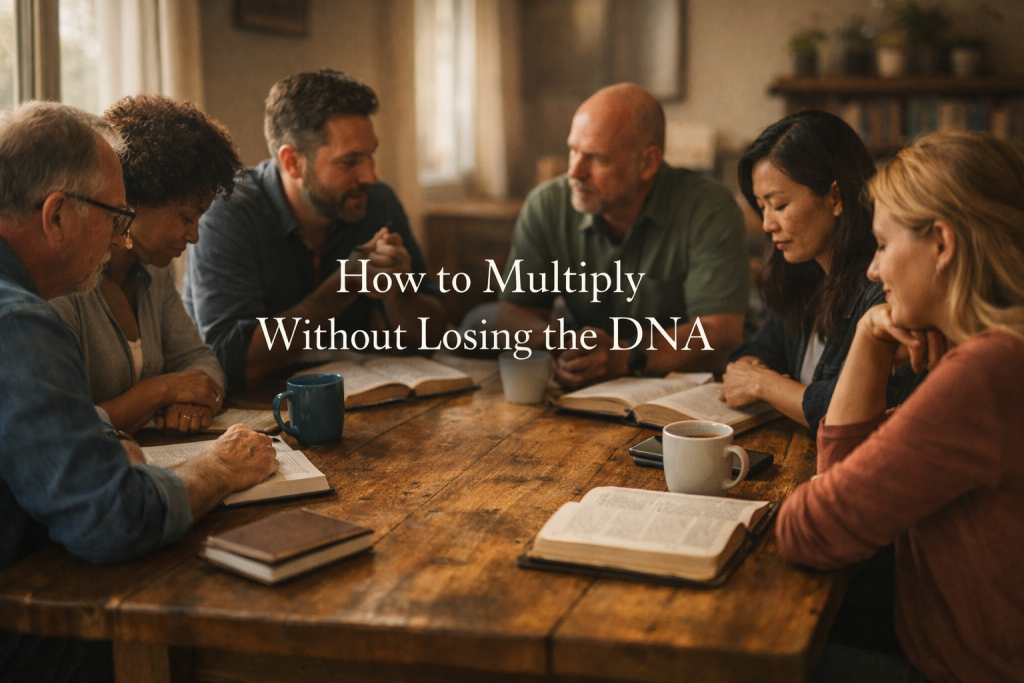
A warm, cinematic portrait of a diverse group of six adults gathered around a rustic wooden table in a softly lit room, engaged in Bible study and conversation. Open Bibles, notebooks, and coffee mugs rest on the table as natural window light casts gentle shadows across the scene. The overlaid title reads, “How to Multiply Without Losing the DNA.”
Discipleship & Multiplication

How to Multiply Without Losing Your DNA

How to Multiply Without Losing the DNA Multiplication is a gift. When disciples begin discipling others, when relational communities form organically, when renewal quietly spreads across environments — homes, workplaces, congregations, networks — something sacred is happening. Life is expanding. Faith is taking root in new soil. The Spirit is at work. But growth, if we are not attentive, can also expose what we have not yet examined. Movements rarely drift because of opposition. More often, they drift because of momentum. As influence widens, complexity increases. As complexity increases, pressure follows. And pressure has a way of revealing whether our roots run deep enough to sustain what is emerging. It is possible to expand and yet slowly lose the very essence that made the work alive. What began centered on Jesus can gradually become centered on outcomes. What began grounded in Scripture can become shaped by personality. What began prayerful can become strategic first and spiritual second. The external form may remain intact, but the interior life begins to thin. For those entrusted with leadership, the question is not merely how to multiply. It is how to steward multiplication without compromising the DNA that defines us. That is sacred work. Key Takeaways Multiplication reveals the depth of our formation. DNA is spiritual essence, not structural format. We reproduce what we embody, not merely what we teach. Expansion must never outrun spiritual depth. What we celebrate quietly shapes our culture. Leaders are to be recognized by fruit, not created by urgency. Alignment is preserved through shared submission to Jesus and Scripture. Multiplication is fruit of faithfulness, not the mission itself. Expression Changes. Essence Cannot. Across the New Testament, the people of God gathered in varied ways — in homes, in temple courts, in marketplaces, by riversides, in rented halls. The structure adapted to context. The confession did not. The apostles did not defend a model. They guarded the gospel. For us, the same distinction must remain clear. Relational expressions of community may take many forms. Some are intimate gatherings around a table. Some form in business environments. Some bring renewal within established congregations. Some emerge through networks of disciple-makers across regions. The container may differ. But the center must remain fixed. Spiritual DNA is not about format. It is about what sits at the heart: Jesus as Lord. Scripture as final authority. The Spirit actively leading. Obedience flowing from encounter. Love shaping community life. Leaders formed in humility. Belonging that creates space for transformation. If these remain intact, diversity of expression strengthens the work. If these shift, even the most faithful-looking structure cannot preserve what matters most. The church has always been called to guard the treasure entrusted to it. That guarding is not defensive — it is faithful. The Pattern of Drift in Scripture Drift is not new. It is visible within the pages of the New Testament itself. The churches in Galatia began in the Spirit but were gradually drawn toward performance. Paul’s question still echoes: “Having begun by the Spirit, are you now being perfected by the flesh?” The issue was not activity; it was dependence. In Corinth, factions formed around leaders. Allegiance shifted subtly from Christ to personalities. The gatherings continued. The gifts operated. But the center wavered. In Ephesus, perseverance and doctrinal clarity remained strong, yet they were warned that they had left their first love. Orthodoxy persisted. Affection thinned. In each case, there was no immediate collapse. There was no sudden abandonment of faith. There was simply a gradual shift in what occupied the center. Multiplication magnifies whatever sits at the center. If Christ remains central, growth deepens worship and humility. If performance or personality becomes central, growth deepens pressure and division. Drift is rarely dramatic. It is incremental. That is why vigilance must be gentle but constant. We Multiply Our Interior Life When Paul instructed Timothy to entrust what he had received to faithful people who would teach others also, he described multiplication across generations. But the emphasis was not merely on transmission of content. It was on the character of those entrusted. Faithful. Leaders reproduce more than ideas. They reproduce posture. Those who walk closely with us are learning: How we respond to disagreement. Whether we confess weakness. Whether Scripture truly governs our decisions. Whether prayer shapes direction or simply blesses it. Whether humility is practiced or merely preached. If we lead from insecurity, insecurity will echo outward.If we lead from ambition, ambition will ripple outward.If we lead from surrendered dependence, that too will multiply. Multiplication does not create character. It reveals it. For this reason, theological depth and identity rooted in grace are not optional. Leaders secure in Christ do not need growth to validate them. They do not need visibility to sustain them. Their stability protects the environment around them. Depth Before Width There is always a temptation in seasons of growth to move quickly. Opportunities increase. Invitations multiply. Leadership demands expand. Yet Scripture consistently ties fruitfulness to abiding. Jesus did not equate impact with acceleration. He equated it with remaining in Him. Formation precedes sending. If expansion outpaces formation, pressure will eventually expose the imbalance. When criticism arises or conflict surfaces, shallow roots struggle. Leaders without deep formation instinctively reach for control or performance. Leaders who have been shaped in prayer and Scripture reach for patience and discernment. Growth is not the problem. Growth without depth is. As stewards, we must resist expanding beyond the depth of our formation. Culture Forms Around What We Honor In every movement, certain stories rise to the surface. What we celebrate communicates what we value. If scale consistently receives affirmation, scale becomes the pursuit. If influence is subtly admired, influence becomes the aspiration. If rapid expansion is equated with faithfulness, patience begins to feel like weakness. But if we consistently honor quiet obedience, costly faithfulness, reconciliation, generosity, and humility under pressure, a different culture forms. The kingdom grows like seed in soil — often unseen before it is visible. Multiplication must remain fruit.

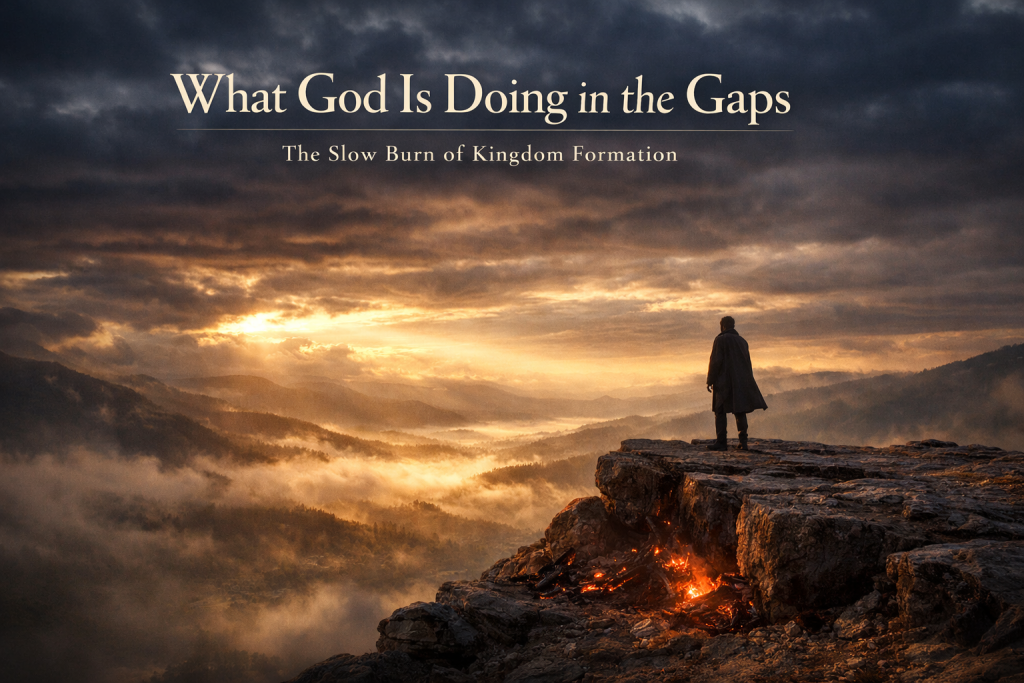
Wide-angle cinematic dawn landscape of a solitary figure standing on a rugged cliff overlooking a mist-covered valley, golden sunlight breaking through dark clouds. Subtle glowing embers burn near the cliff edge. In the sky, elegant serif title text reads “What God Is Doing in the Gaps” with the subtitle “The Slow Burn of Kingdom Formation.”
Apostolic Journey & Desolate Places

What God Is Doing in Your Waiting Season

The Slow Burn of Kingdom Formation I. Introduction: The Fear of the Gap The invitations slow. The momentum stalls. The door that seemed certain closes without explanation. Your influence feels smaller.Your voice feels quieter.Your progress feels delayed. And the whisper rises: Did I miss God? Leaders are addicted to movement. We measure fruit by expansion.We measure obedience by visibility.We measure calling by acceleration. But here is the truth most leaders resist: The gap is not where God pauses your calling — it is where He purifies it. Delay is not divine hesitation.It is divine refinement. What feels like loss is often reduction for strength.What feels like silence is often surgical precision. If you are in a gap, you are not abandoned. You are being rebuilt. Key Takeaways Hiddenness is not punishment — it is preparation. God deepens before He displays. Reduction precedes authority. Waiting exposes false dependencies. Fast growth produces fragile leaders. Slow burn produces immovable ones. If God has slowed you down, He is increasing your weight. II. The Lie of Immediate Momentum The modern church worships speed. We assume that if God is in it, it will expand quickly. That is not Kingdom thinking. Jesus was hidden for 30 years. David was hunted before he was crowned. Joseph was imprisoned before he governed nations. God builds leaders the way He builds foundations — underground first. Silence does not mean stagnation. Silence means excavation. Waiting is not weakness. Waiting is warfare against impatience. If you cannot endure obscurity, you cannot steward influence. III. The Pattern You Cannot Escape Every Kingdom assignment follows a pattern: Promise Hiddenness Testing Reduction Release You do not skip hiddenness. You do not bypass testing. You do not negotiate reduction. The leader who tries to outrun this process collapses under the weight of what they prayed for. Hiddenness is not interruption. It is initiation. IV. Elijah: Detox Before Fire Elijah confronted kings. Then God sent him to a brook. Alone.Dependent.Reduced. The brook dried up. That was not failure. That was detox. God was stripping Elijah of visible strength so that heaven could trust him with visible power. Then came Carmel. Fire from heaven did not come from charisma. It came from hidden dependence. And when Elijah collapsed in the cave? God did not scold him. God recalibrated him. If you are in a cave, God is not punishing you. He is purifying your identity. V. Jeremiah: Obedience Without Applause Jeremiah preached. They ignored him. He warned. They resisted. He wept. Nothing changed. Would you stay if revival never came? Would you obey if fruit never surfaced? Jeremiah’s success was not measured in crowds. It was measured in faithfulness. The gap does not guarantee applause. It guarantees exposure of your motives. VI. Discern the Gap Not all slow seasons are equal. The Consequence Gap God is correcting you.Conviction is sharp.Exposure is mercy. The Formation Gap God is strengthening you.Intimacy increases.Clarity deepens. The Transition Gap God is repositioning you.Old grace lifts.New direction is forming. Discernment matters. But in all three, one thing is certain: God is not inactive. VII. What God Is Actually Doing He is purifying your motives. He is breaking your addiction to validation. He is strengthening internal structure. He is removing the need to be seen. He is increasing your spiritual weight. Authority in the Kingdom is not granted by position. It is forged in surrender. The gap reveals what you were leaning on. And God will remove whatever competes with Him. VIII. The Slow Burn vs. The Flash Fire Flash fire: Rapid growth Shallow roots Loud influence Fragile leaders Slow burn: Deep roots Quiet strength Durable authority Leaders who cannot be shaken The world celebrates flash. Heaven builds slow burn. If God has slowed you down, He is protecting you from premature exposure. IX. How to Lead in the Gap Do not manufacture momentum. Do not scramble for relevance. Do not chase platforms. Abide. Listen. Obey the small things. Write down what God says. Refuse to move until He moves you. Isolation will distort you — stay connected to trusted voices. And above all, surrender fully. Half-surrender prolongs formation. Full surrender stabilizes it. Leadership Reflection Ask the Lord: What ambition are You removing? What dependency are You exposing? What identity are You dismantling? What strength are You building? Sit until the answer unsettles you. That is where formation begins. X. The Promise of the Slow Burn You are not behind. You are under construction. God is not withholding promotion. He is building capacity. He is not silencing you. He is sharpening you. He is not shrinking your influence. He is strengthening your core. The gap is not empty. It is holy ground. Hidden seasons produce leaders who cannot be manipulated, intimidated, or destroyed. The fire that lasts is rarely lit quickly. But when it burns, it does not go out. FAQs How long will this gap last? As long as it takes for the internal structure to match the external assignment. Can I accelerate the process? Only through surrender. Resistance prolongs it. Obedience stabilizes it. How do I know if this is formation and not failure? Failure drives you from God. Formation drives you into Him. Should I make major moves during this season? Not unless the Lord speaks clearly. Gaps are for rooting, not scrambling. Why does this feel like loss? Because something is dying. And what dies in you makes room for what must live through you. What is the greatest danger in the gap? Premature movement. Grasping for visibility. Forcing what God is still forming.

Missional team praying around an open Bible beside a table, with a tree showing deep roots in the background, symbolizing Spirit-led, rooted, and reproducible leadership.
Apostolic Journey & Desolate Places

How Missional Teams Stay Rooted, Reproducible, and Spirit-Led

Introduction: Why Missional Teams Are Burning Out—and How to Build Differently Across the global Church and marketplace mission field, a pattern has become impossible to ignore. Teams are launching fast, carrying genuine vision, and seeing early fruit—yet many are quietly unraveling beneath the surface. Burnout is normalized. Fragmentation is common. Leaders feel pressure to sustain momentum without losing their souls or their people. The problem is not a lack of passion, gifting, or opportunity.The problem is formation. Too many missional teams are built on personality, programs, or pressure rather than on Spirit-led rhythms. When urgency replaces discernment and productivity replaces presence, even well-intentioned Kingdom efforts begin to drift. What starts as obedience slowly becomes maintenance. What begins in faith quietly shifts into force. As we move into 2026, the Spirit is not calling leaders to do more, but to build deeper. Teams that endure and multiply will not be the loudest or the most resourced—they will be the most rooted, the most relationally healthy, and the most reproducible. This article explores three essential rhythms that must be intentionally cultivated if missional teams are to remain faithful, fruitful, and Spirit-led for the long haul. Key Takeaways Presence precedes power—and power pursued without presence often mutates into control. Teams rarely collapse from lack of gifting; they collapse from unaddressed drift. Relational fracture is seldom sudden; it is usually tolerated tension over time. Reproducibility is not merely a strategy—it is a sign of spiritual maturity. Irreplaceable leaders create fragile movements. The Spirit must be trusted not only for empowerment, but for direction. What a team normalizes in its culture will eventually multiply through its mission. Rhythmic Leadership vs. Reactionary Leadership One of the clearest dividing lines between teams that endure and teams that implode is the difference between rhythmic leadership and reactionary leadership. Reactionary leadership is driven by urgency. Decisions are made in response to pressure, needs, or opportunities without space for discernment. The team is always responding, always adjusting, always busy—yet rarely still. Over time, this pace dulls spiritual sensitivity, strains relationships, and exhausts leaders. Rhythmic leadership is different. It is anchored in intentional spiritual pace. It recognizes that the Kingdom advances through obedience, not adrenaline. Leaders who live rhythmically are not passive; they are attentive—to God, to people, and to timing. Jesus modeled this consistently. He withdrew to pray. He resisted being rushed by crowds. He moved with clarity because He lived from communion with the Father. That pace produced fruit that remained. Missional teams shaped by rhythmic leadership learn to ask a different question. Not “What needs to be done next?” but “What is the Spirit saying now?” That shift quietly reorders everything. Rhythm One: The Rhythm of Abiding Staying Rooted in God’s Presence Every sustainable missional movement begins here. Abiding is not a private spiritual luxury; it is a corporate necessity. Jesus’ words are unambiguous: “Apart from Me you can do nothing” (John 15:5). Teams may remain active for a season, but disconnected from the Vine they lose the capacity to bear lasting fruit. For a missional team, abiding means more than individual devotional discipline. It is a shared commitment to prayer, Scripture, worship, and listening together. It means leaders modeling intimacy with God rather than substituting activity for dependence. It means making space for repentance and restoration—because “He restores my soul” (Psalm 23:3) is not poetry; it is survival. Practically, teams that abide pray before they plan, listen before they launch, and allow Scripture to govern decisions rather than merely support vision. Worship becomes alignment, not atmosphere. Silence becomes as valuable as strategy. Drift warning: when a team loses abiding, it replaces dependence with drive—and spiritual authority with spiritual exhaustion. Team Practice (next 7 days):Schedule one unhurried, agenda-free team prayer time focused solely on listening and Scripture—not planning or problem-solving. Rhythm Two: The Rhythm of Relating Staying Healthy, Honest, and Aligned Together No missional team collapses suddenly. They fracture relationally long before they fail publicly. The early church “devoted themselves” to shared life (Acts 2:42). Unity was practiced, not presumed. Scripture also names the danger clearly: “Encourage one another daily… so that none of you may be hardened” (Hebrews 3:13). Hardness forms where truth is delayed. The longer a team exists, the more relational health becomes decisive. Unaddressed offense leaks into mission. Hidden resentment distorts communication. Avoided conversations eventually sabotage discernment. The rhythm of relating requires intentional practices: confession without fear, encouragement without manipulation, and alignment without control. It requires leaders who are approachable, not insulated—and teams willing to “speak the truth in love” (Ephesians 4:15) rather than spiritualize avoidance. Healthy teams address tension early, before it calcifies. They refuse to sacrifice truth for false peace. They understand that unity is not the absence of disagreement, but the presence of trust. Drift warning: when relating breaks down, teams often compensate with structure or intensity—trying to organize what only humility and repentance can heal. Team Practice (next 7 days):Create intentional space for one honest relational check-in where team members can name tension, fatigue, or misalignment without correction or defense. Rhythm Three: The Rhythm of Releasing Staying Reproducible and Spirit-Multiplied Reproducibility is not primarily a growth strategy—it is a discipleship issue. Paul’s instruction is straightforward: entrust what you’ve received to faithful people who can teach others (2 Timothy 2:2). This is not optional for movements; it is the pattern. Missional teams that endure are not built around irreplaceable leaders. They are built around transferable rhythms. Authority is shared. Responsibility is distributed. Jesus did not build a ministry dependent on His physical presence; He trained, entrusted, and released. The rhythm of releasing means training people to hear God, not merely execute instructions. It means delegating authority, not just tasks. It means celebrating multiplication even when it costs comfort, control, or familiarity. Drift warning: teams that refuse to release eventually become bottlenecked, personality-driven, and fragile—no matter how successful they appear. A team that releases without formation creates chaos. A team that refuses to release creates stagnation. Wisdom is found in Spirit-led

Kingdom Mission in the Marketplace
Discipleship & Multiplication

Kingdom Mission in the Marketplace: Simplicity 3.0 in Action

Marketplace Ministry & Mission: Simplicity 3.0 in Motion In a world obsessed with platforms and performance, the Spirit is birthing something quieter, deeper—and far more transformative. It’s not happening in boardrooms or on stages, but in the ordinary rhythms of work, relationship, and obedience. This is the essence of Simplicity 3.0: discipleship without pretense, leadership without hierarchy, and mission without walls. We’ve witnessed this reality take form in powerful ways across Kenya—in both Eldoret and Nakuru—where the Spirit moved in distinctly different, yet deeply connected expressions of marketplace ministry and global mission. Key Takeaways Simplicity 3.0 prioritizes presence over program and people over platforms.It’s about Spirit-led discipleship in the everyday places—home, work, community—not just within church walls. Marketplace ministry is not secondary—it’s central.God is raising up entrepreneurs, innovators, and workers to live missionally through their vocations. Maturity precedes multiplication.Eldoret revealed that long-term fruitfulness comes through faithful discipleship, not fast-track leadership. Activation requires alignment.In Nakuru, the Spirit catalyzed marketplace leaders not just with strategy, but with identity rooted in the Kingdom. The future of mission is decentralized, Spirit-empowered, and reproducible.Whether in a remote village or a tech hub, the tools and vision of Simplicity Church Network can equip every believer to live on mission. Eldoret: Maturity That Multiplies In Eldoret, the focus was formation. Leaders from Pastor Margaret Maheri’s network came together not to chase platforms, but to pursue Christlikeness. Our theme—maturity in Christ—wasn’t new, but it landed with fresh weight. We spoke about the difference between knowing about Jesus and becoming like Him—not just in church, but in the home, the marketplace, and community life. What emerged wasn’t a new program—it was hunger. You could feel it in the worship, in the lingering prayers, in the way leaders leaned in to ask better questions.  One powerful example: Victor, Pastor Margaret’s son-in-law. Years ago, he was the smiling usher at the church door. Today, he pastors one of her seven churches with humility and wisdom. His growth wasn’t driven by titles or conferences—it was forged in discipleship, faithfulness, and spiritual community. This is what Simplicity values most: presence over program, relationship over structure, and formation that leads to multiplication. Nakuru: Commissioning for the Marketplace In Nakuru, we saw the other side of the coin: activation. Over 100 entrepreneurs, ministry leaders, and students gathered under the banner:Kingdom Vision. Entrepreneurial Execution. Legacy Impact. For three days, the Spirit moved powerfully as we explored: Kingdom-first identity AI and innovation as tools for purpose Wealth and finance as stewardship Leadership development and emotional intelligence Marketplace as ministry This wasn’t just theory. It was a prophetic commissioning. “Now I know God makes leaders—not just learners.”“Learning about AI, mindset, and money changed everything.” By the final session, dozens had received clarity about their callings in business, leadership, and mentorship. Many left ready to launch new ventures, disciple the next generation, and steward technology for the Kingdom. The atmosphere was electric—with purpose, vision, and urgency. And yet, the hunger was the same as in Eldoret. The Simplicity 3.0 DNA: Mission Without Walls Whether in rural churches or urban business hubs, the thread running through both gatherings was unmistakable: The marketplace is not a distraction from God’s mission—it’s a primary place where it unfolds. Simplicity 3.0 carries a deep conviction that: Every believer is called to make disciples, wherever they are Business is not secular—it’s spiritual Work can be worship Innovation can be obedience Local mission is global mission when rooted in the Spirit This is why we equip believers with tools like The Foundry, simple leadership pathways, and marketplace intensives. Not to build an institution—but to spark a Kingdom movement among ordinary people living on mission in everyday spaces. What’s Next We’re leaning into the momentum with clarity and intentionality. Upcoming developments include: Discipleship cohorts across Africa and beyond Marketplace intensives for entrepreneurs and creators Mentorship ecosystems using The Foundry framework Localized training for youth and emerging leaders The harvest is not in the building—it’s in the field. And the workers are already being raised up. “Whatever you do, work at it with all your heart, as working for the Lord.”— Colossians 3:23 “Make disciples… as you are going…”— Matthew 28:19 (paraphrased) This is Simplicity Church Network.Kingdom first. Marketplace included. Mission always. Frequently Asked Questions (FAQs) Q: What is Simplicity 3.0?A: Simplicity 3.0 is the next expression of the Simplicity Church Network—emphasizing Spirit-led discipleship, decentralized leadership, and marketplace mission. It removes institutional barriers to focus on formation, obedience, and reproducibility. Q: How is marketplace ministry different from traditional ministry?A: Marketplace ministry equips believers to see their work and business as worship. It treats the workplace as a mission field and trains people to lead, disciple, and innovate from a Kingdom perspective—without separating the sacred from the secular. Q: Do I need to be a pastor or entrepreneur to be involved?A: Not at all. Simplicity 3.0 is for all believers—students, homemakers, professionals, creatives, and retirees. If you want to grow in maturity and live missionally, there’s a place for you. Q: What tools are available to help me get started?A: We offer free, downloadable resources like: The Foundry (a 52-week discipleship journey) Leadership development guides for emerging leaders Marketplace intensives for Kingdom entrepreneursAll are available at simplicitychurchnetwork.com/resources Q: How can I bring this to my church, business, or small group?A: Reach out to our team through the contact form. We’d love to help you launch a cohort, train leaders, or facilitate a marketplace activation event in your context.

children's class Eldoret Kenya
Discipleship & Multiplication

Raising Disciple-Makers in Eldoret

Discipleship and Maturity: Notes from Eldoret When we talk about simplicity, we often describe it as presence over program and relationship over structure. In Eldoret, Kenya, that reality came alive in beautiful, tangible ways. Key Takeaways Discipleship is for everyone—not just pastors or church leaders. Every believer is called to help others grow in Christ. Spiritual maturity happens in everyday places—through relationships, obedience, and the slow work of the Spirit, not just events or classes. Raising up leaders requires time and trust. Victor’s journey from greeter to pastor over 13 years shows the fruit of long-term investment and community discipleship. Resources for multiplication matter. Tools like the one-year discipleship journey and leadership guides equip churches to grow and reproduce simply. The hunger for growth is global. What’s happening in Eldoret reflects a broader movement of Spirit-led believers seeking to live out their faith in ordinary, powerful ways. Simple churches can multiply deeply. With the right support, relational leadership, and the Spirit’s guidance, even rural or resource-limited communities can raise strong leaders and plant new expressions of church. Last weekend, leaders from two of Pastor Margaret Maheri’s congregations gathered to grow together around one theme: maturity in Christ. For many, this wasn’t a new idea—but the Spirit gave it fresh weight. We talked about what it means to move beyond knowing about Jesus to becoming more like Him in the everyday places of life—at home, in the marketplace, and in the community. On Sunday, the church gathered to hear about the call to make disciples. We shared how this commission isn’t reserved for pastors or missionaries—it belongs to all of us. Every believer is invited into the life-long rhythm of learning from Jesus and walking with others as they do the same. That message hit home for me in a personal way as I spent time with Victor, Pastor Margaret’s son-in-law. Nearly 13 years ago, when I first met him, Victor was serving faithfully as an Usher at the church door in Langas—warm, humble, and welcoming. Today, he and his wife are pastoring one of the seven churches Margaret oversees. What I saw this weekend was no longer just the smile of a servant—but the heart of a shepherd. His growth didn’t come from a classroom or a conference. It came through faithfulness, discipleship, and community—and it’s bearing fruit. Who around me is quietly growing, waiting to be invited deeper into leadership?Who in your own community is ready for that same next step? Throughout the weekend, Pastor Margaret and I had extended time together talking about leadership development and preparing the next generation who are already beginning to carry the weight of ministry. Her passion for raising up new leaders is deeply rooted in her lived experience—leaders like Victor who have grown up in the soil of simplicity, service, and spiritual maturity. To help fuel this next season of growth, I introduced her to several training and discipleship resources we’ve made available through Simplicity Church Network. These include: A one-year discipleship journey for small groups and families A suite of individual spiritual formation tools Simple leadership development guides for emerging leaders and church planters All of these tools are now available for download at:https://simplicitychurchnetwork.com/resources What stood out most in Eldoret wasn’t the content—it was the hunger. You could see it in their questions, in the worship, and in the way leaders lingered long after we finished—praying with one another, opening their Bibles, encouraging the younger ones. This is the heartbeat of Simplicity Church Network: helping ordinary believers live extraordinary lives through the power of the Holy Spirit. Whether in Kenya, Kansas, or anywhere else, the invitation is the same—to grow up in Christ and multiply what He’s doing in us into the lives of others. “We proclaim Him, admonishing and teaching everyone with all wisdom, so that we may present everyone fully mature in Christ.”—Colossians 1:28 Want to Multiply This in Your Community? Invite a few people to walk through the Discipleship Journey together. Look for the “Victors” around you—people quietly growing, ready to lead. Use the Leadership Development Guides to equip someone to start a new group or spiritual conversation space. All of these free resources are available here:https://simplicitychurchnetwork.com/resources What’s happening in Eldoret is just one expression of a larger movement—a growing family of believers learning to live simply, love deeply, and follow the Spirit into the everyday places of life. It’s not about replicating a model. It’s about releasing the presence of Jesus—right where people already are. Frequently Asked Questions 1. What is the main focus of the work in Eldoret, Kenya?The focus is on encouraging spiritual maturity, equipping leaders for discipleship, and helping local churches grow through simple, Spirit-led practices rooted in everyday life. 2. Who is Pastor Margaret Maheri?Pastor Margaret Maheri is a Kenyan church planter who has been faithfully leading and multiplying churches in rural and underserved communities for over 25 years. 3. Who is Victor, and why is his story significant?Victor is Pastor Margaret’s son-in-law. Thirteen years ago, he served as a church usher. Today, he and his wife pastor one of the seven churches Margaret oversees. His story reflects the fruit of relational discipleship and long-term investment. 4. What resources were shared with the churches in Eldoret?Carl introduced a one-year discipleship journey, personal spiritual formation tools, and simple leadership development guides—all available for free at simplicitychurchnetwork.com/resources 5. How can I use these resources in my own church or group?You can download and adapt the resources for small groups, family discipleship, leadership training, or launching new simple churches. They’re designed to be flexible, reproducible, and Spirit-led. 6. Can this model work outside of Kenya?Yes! The Simplicity Church Network model is designed for any context—urban, rural, cross-cultural, or digital. It’s about carrying the presence of Jesus into everyday spaces, not replicating a program. 7. How can I get involved or support this work?You can explore resources, start a front porch movement in your own community, or support future global equipping trips through prayer, partnership, or

Scroll to Top