Simplicity Church Network

Integrating Faith and Work: Sustainable Leadership for Today

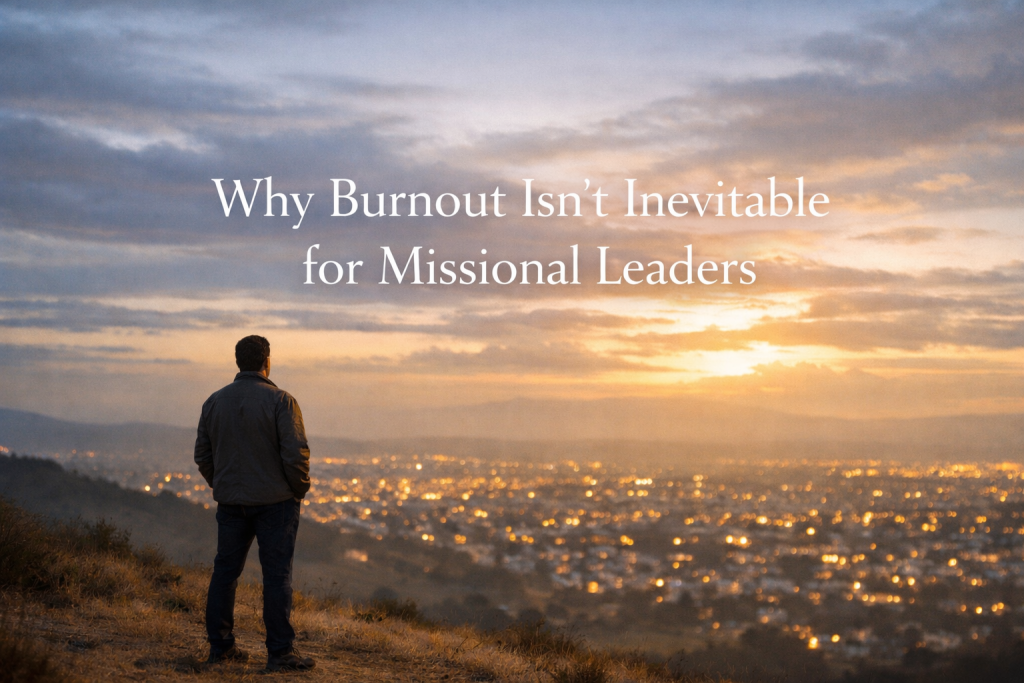
Person standing on a hillside overlooking a city at sunset, with text overlay: "Why Burnout Isn’t Inevitable for Missional Leaders," symbolizing reflection and leadership in the context of burnout prevention.
Leadership & Soul Care

Why Burnout Isn’t Inevitable for Missional Leaders

🔥 Burnout Is Not the Price of Obedience Most missional leaders don’t burn out because they stopped loving God. They burn out because they loved people deeply… and quietly stopped listening to their own soul. Burnout rarely shows up as rebellion.It shows up as faithfulness without limits. It looks like: answering one more text late at night because “they really need me” skipping rest because “this season is critical” absorbing conflict without processing it carrying responsibility God never verbally assigned And somewhere along the way, exhaustion gets baptized. “This is just the cost of obedience.”“This is what it means to pour yourself out.” But Scripture never teaches that obedience requires the erosion of the soul. Jesus carried the weight of the world’s redemption.He faced relentless need, unending crowds, constant misunderstanding, spiritual warfare, betrayal, and the shadow of the cross. And yet—He never burned out. He was fully present.Deeply obedient.Utterly surrendered. But never frantic.Never hollowed out.Never driven by guilt or fear. Which forces an uncomfortable question for every missional leader: If Jesus never burned out, why have we normalized it as inevitable? ✅ Key Takeaways (Read These Slowly) Burnout is not proof of faithfulness; it is often evidence of misplaced responsibility. Urgency does not equal obedience—Jesus routinely disengaged from real need. Most burnout is fueled by false inner vows, not external pressure. Sustainable mission flows from abiding, not overextension. God never intended leaders to carry the mission alone. 🧱 The Quiet Beliefs That Drain Missional Leaders Burnout is rarely caused by workload alone.It is fed by beliefs we never stop to examine. 1. “If I don’t do it, it won’t get done.” This belief usually forms honestly. You stepped in when no one else would.You carried things others dropped.You proved reliable. And eventually, responsibility turned into identity. “If I step back, things fall apart.” But Scripture has a name for this. When Moses carried Israel alone—leading, judging, solving, absorbing—God did not commend his sacrifice. He confronted it. “What you are doing is not good… You will surely wear yourself out.”(Exodus 18:17–18) Burnout often isn’t the result of too much obedience.It’s the result of taking ownership of outcomes God never assigned to you. Faithfulness does not require omnipresence. 2. “The needs are too urgent to rest.” This belief feels spiritual.It sounds compassionate.It feels responsible. But it is not how Jesus lived. Picture the moment:Crowds pressing in.The sick waiting.Disciples overwhelmed. And Jesus… withdraws. “But Jesus often withdrew to lonely places and prayed.”(Luke 5:16) This wasn’t avoidance.It was alignment. Jesus understood something missional leaders forget: Meeting every need is not the same as obeying the Father. Urgency does not lead the Kingdom.The Spirit does. 3. “Burnout is just the cost of being faithful.” Sacrifice is biblical.Self-neglect is not. God commanded Sabbath before Israel entered the Promised Land—not as a luxury, but as a declaration: “You are not slaves anymore.” “In returning and rest you shall be saved;in quietness and trust shall be your strength.”(Isaiah 30:15) When leaders confuse hustle with holiness, burnout is not heroic—it is predictable. 🌱 The Jesus Pattern: Leadership From Overflow, Not Overreach Jesus did not organize His days around need. He organized His life around listening. “The Son can do nothing by Himself;He can do only what He sees His Father doing.”(John 5:19) That single sentence dismantles most modern leadership models. Jesus healed many—but not all.He taught crowds—but invested in a few.He walked away from opportunity when the Father said no. He could disappoint people without violating obedience. Burnout is often the fruit of compassion disconnected from discernment. Jesus loved fully—but He listened first. 🔄 The Rhythms That Keep Leaders Alive These are not productivity hacks.They are survival rhythms forged under pressure. 1. Abiding Before Doing Abiding is not sermon prep.It is not strategic prayer. It is the daily re-centering of identity. “Apart from Me you can do nothing.”(John 15:5) Most leaders don’t drift because they stop believing.They drift because they stop being still long enough to remember who they are before they lead. 2. Soul-Level Relationships Many leaders have meetings.Few have mirrors. Scripture assumes leaders will confess, be known, and be held. “Carry each other’s burdens…”(Galatians 6:2) Isolation is not strength.It is the soil burnout grows in. 3. Sabbath as Resistance Sabbath is an act of defiance. It says: God can move without me The world will not collapse if I stop My worth is not my output Burnout often reveals a truth we resist: There is a burden you were never meant to carry alone. 4. Shared Leadership, Not Lone Shepherding Jesus empowered others.He released authority.He trusted the Spirit at work beyond Himself. If everything depends on you, something is wrong. 🌊 What Obedience Without Burnout Actually Looks Like It looks like leaders who are: fruitful but not frantic rested but not disengaged honest about limits quick to repent of false responsibility able to say yes without resentment and no without guilt These leaders don’t quit the mission. They outlast it. 🛠 Tools That Support Long-Term Faithfulness Not solutions—supports. Resilient Shepherd Manual – for leaders carrying long-term weight Recharge & Renewal Guides – for burned or burning leaders Weekly soul check-ins that ask “How are you?” before “What’s next?” Tools don’t replace the Spirit.They simply protect space to listen. 🔚 Final Word: You’re Not Called to Burn Out You are called to burn bright. Jesus does not measure faithfulness by exhaustion.He measures it by obedience rooted in love. “Come to Me, all who are weary and burdened,and I will give you rest.”(Matthew 11:28) Your soul matters more to God than your output.Always has.Always will. Lead from the secret place.Let go of what was never yours to carry.And trust that God does not need your exhaustion to accomplish His will. ❓ FAQs (Because Leaders Ask These Quietly) Isn’t burnout inevitable if you really care?No. Caring deeply requires better boundaries, not weaker ones. What if people suffer when I slow down?You are responsible for obedience, not outcomes. Is rest selfish when the mission is urgent?No. Rest is trust in

Audience engaged in a marketplace ministry session, speaker presenting at podium, flags of various countries in the background, emphasis on discipleship and community involvement.
Discipleship & Multiplication

Kingdom Mission in the Marketplace: Simplicity 3.0 in Action

Marketplace Ministry & Mission: Simplicity 3.0 in Motion In a world obsessed with platforms and performance, the Spirit is birthing something quieter, deeper—and far more transformative. It’s not happening in boardrooms or on stages, but in the ordinary rhythms of work, relationship, and obedience. This is the essence of Simplicity 3.0: discipleship without pretense, leadership without hierarchy, and mission without walls. We’ve witnessed this reality take form in powerful ways across Kenya—in both Eldoret and Nakuru—where the Spirit moved in distinctly different, yet deeply connected expressions of marketplace ministry and global mission. Key Takeaways Simplicity 3.0 prioritizes presence over program and people over platforms.It’s about Spirit-led discipleship in the everyday places—home, work, community—not just within church walls. Marketplace ministry is not secondary—it’s central.God is raising up entrepreneurs, innovators, and workers to live missionally through their vocations. Maturity precedes multiplication.Eldoret revealed that long-term fruitfulness comes through faithful discipleship, not fast-track leadership. Activation requires alignment.In Nakuru, the Spirit catalyzed marketplace leaders not just with strategy, but with identity rooted in the Kingdom. The future of mission is decentralized, Spirit-empowered, and reproducible.Whether in a remote village or a tech hub, the tools and vision of Simplicity Church Network can equip every believer to live on mission. Eldoret: Maturity That Multiplies In Eldoret, the focus was formation. Leaders from Pastor Margaret Maheri’s network came together not to chase platforms, but to pursue Christlikeness. Our theme—maturity in Christ—wasn’t new, but it landed with fresh weight. We spoke about the difference between knowing about Jesus and becoming like Him—not just in church, but in the home, the marketplace, and community life. What emerged wasn’t a new program—it was hunger. You could feel it in the worship, in the lingering prayers, in the way leaders leaned in to ask better questions.  One powerful example: Victor, Pastor Margaret’s son-in-law. Years ago, he was the smiling usher at the church door. Today, he pastors one of her seven churches with humility and wisdom. His growth wasn’t driven by titles or conferences—it was forged in discipleship, faithfulness, and spiritual community. This is what Simplicity values most: presence over program, relationship over structure, and formation that leads to multiplication. Nakuru: Commissioning for the Marketplace In Nakuru, we saw the other side of the coin: activation. Over 100 entrepreneurs, ministry leaders, and students gathered under the banner:Kingdom Vision. Entrepreneurial Execution. Legacy Impact. For three days, the Spirit moved powerfully as we explored: Kingdom-first identity AI and innovation as tools for purpose Wealth and finance as stewardship Leadership development and emotional intelligence Marketplace as ministry This wasn’t just theory. It was a prophetic commissioning. “Now I know God makes leaders—not just learners.”“Learning about AI, mindset, and money changed everything.” By the final session, dozens had received clarity about their callings in business, leadership, and mentorship. Many left ready to launch new ventures, disciple the next generation, and steward technology for the Kingdom. The atmosphere was electric—with purpose, vision, and urgency. And yet, the hunger was the same as in Eldoret. The Simplicity 3.0 DNA: Mission Without Walls Whether in rural churches or urban business hubs, the thread running through both gatherings was unmistakable: The marketplace is not a distraction from God’s mission—it’s a primary place where it unfolds. Simplicity 3.0 carries a deep conviction that: Every believer is called to make disciples, wherever they are Business is not secular—it’s spiritual Work can be worship Innovation can be obedience Local mission is global mission when rooted in the Spirit This is why we equip believers with tools like The Foundry, simple leadership pathways, and marketplace intensives. Not to build an institution—but to spark a Kingdom movement among ordinary people living on mission in everyday spaces. What’s Next We’re leaning into the momentum with clarity and intentionality. Upcoming developments include: Discipleship cohorts across Africa and beyond Marketplace intensives for entrepreneurs and creators Mentorship ecosystems using The Foundry framework Localized training for youth and emerging leaders The harvest is not in the building—it’s in the field. And the workers are already being raised up. “Whatever you do, work at it with all your heart, as working for the Lord.”— Colossians 3:23 “Make disciples… as you are going…”— Matthew 28:19 (paraphrased) This is Simplicity Church Network.Kingdom first. Marketplace included. Mission always. Frequently Asked Questions (FAQs) Q: What is Simplicity 3.0?A: Simplicity 3.0 is the next expression of the Simplicity Church Network—emphasizing Spirit-led discipleship, decentralized leadership, and marketplace mission. It removes institutional barriers to focus on formation, obedience, and reproducibility. Q: How is marketplace ministry different from traditional ministry?A: Marketplace ministry equips believers to see their work and business as worship. It treats the workplace as a mission field and trains people to lead, disciple, and innovate from a Kingdom perspective—without separating the sacred from the secular. Q: Do I need to be a pastor or entrepreneur to be involved?A: Not at all. Simplicity 3.0 is for all believers—students, homemakers, professionals, creatives, and retirees. If you want to grow in maturity and live missionally, there’s a place for you. Q: What tools are available to help me get started?A: We offer free, downloadable resources like: The Foundry (a 52-week discipleship journey) Leadership development guides for emerging leaders Marketplace intensives for Kingdom entrepreneursAll are available at simplicitychurchnetwork.com/resources Q: How can I bring this to my church, business, or small group?A: Reach out to our team through the contact form. We’d love to help you launch a cohort, train leaders, or facilitate a marketplace activation event in your context.

Group of children and adults in Eldoret, Kenya, standing together outdoors, showcasing community and relationships in a discipleship context.
Discipleship & Multiplication

Raising Disciple-Makers in Eldoret

Discipleship and Maturity: Notes from Eldoret When we talk about simplicity, we often describe it as presence over program and relationship over structure. In Eldoret, Kenya, that reality came alive in beautiful, tangible ways. Key Takeaways Discipleship is for everyone—not just pastors or church leaders. Every believer is called to help others grow in Christ. Spiritual maturity happens in everyday places—through relationships, obedience, and the slow work of the Spirit, not just events or classes. Raising up leaders requires time and trust. Victor’s journey from greeter to pastor over 13 years shows the fruit of long-term investment and community discipleship. Resources for multiplication matter. Tools like the one-year discipleship journey and leadership guides equip churches to grow and reproduce simply. The hunger for growth is global. What’s happening in Eldoret reflects a broader movement of Spirit-led believers seeking to live out their faith in ordinary, powerful ways. Simple churches can multiply deeply. With the right support, relational leadership, and the Spirit’s guidance, even rural or resource-limited communities can raise strong leaders and plant new expressions of church. Last weekend, leaders from two of Pastor Margaret Maheri’s congregations gathered to grow together around one theme: maturity in Christ. For many, this wasn’t a new idea—but the Spirit gave it fresh weight. We talked about what it means to move beyond knowing about Jesus to becoming more like Him in the everyday places of life—at home, in the marketplace, and in the community. On Sunday, the church gathered to hear about the call to make disciples. We shared how this commission isn’t reserved for pastors or missionaries—it belongs to all of us. Every believer is invited into the life-long rhythm of learning from Jesus and walking with others as they do the same. That message hit home for me in a personal way as I spent time with Victor, Pastor Margaret’s son-in-law. Nearly 13 years ago, when I first met him, Victor was serving faithfully as an Usher at the church door in Langas—warm, humble, and welcoming. Today, he and his wife are pastoring one of the seven churches Margaret oversees. What I saw this weekend was no longer just the smile of a servant—but the heart of a shepherd. His growth didn’t come from a classroom or a conference. It came through faithfulness, discipleship, and community—and it’s bearing fruit. Who around me is quietly growing, waiting to be invited deeper into leadership?Who in your own community is ready for that same next step? Throughout the weekend, Pastor Margaret and I had extended time together talking about leadership development and preparing the next generation who are already beginning to carry the weight of ministry. Her passion for raising up new leaders is deeply rooted in her lived experience—leaders like Victor who have grown up in the soil of simplicity, service, and spiritual maturity. To help fuel this next season of growth, I introduced her to several training and discipleship resources we’ve made available through Simplicity Church Network. These include: A one-year discipleship journey for small groups and families A suite of individual spiritual formation tools Simple leadership development guides for emerging leaders and church planters All of these tools are now available for download at:https://simplicitychurchnetwork.com/resources What stood out most in Eldoret wasn’t the content—it was the hunger. You could see it in their questions, in the worship, and in the way leaders lingered long after we finished—praying with one another, opening their Bibles, encouraging the younger ones. This is the heartbeat of Simplicity Church Network: helping ordinary believers live extraordinary lives through the power of the Holy Spirit. Whether in Kenya, Kansas, or anywhere else, the invitation is the same—to grow up in Christ and multiply what He’s doing in us into the lives of others. “We proclaim Him, admonishing and teaching everyone with all wisdom, so that we may present everyone fully mature in Christ.”—Colossians 1:28 Want to Multiply This in Your Community? Invite a few people to walk through the Discipleship Journey together. Look for the “Victors” around you—people quietly growing, ready to lead. Use the Leadership Development Guides to equip someone to start a new group or spiritual conversation space. All of these free resources are available here:https://simplicitychurchnetwork.com/resources What’s happening in Eldoret is just one expression of a larger movement—a growing family of believers learning to live simply, love deeply, and follow the Spirit into the everyday places of life. It’s not about replicating a model. It’s about releasing the presence of Jesus—right where people already are. Frequently Asked Questions 1. What is the main focus of the work in Eldoret, Kenya?The focus is on encouraging spiritual maturity, equipping leaders for discipleship, and helping local churches grow through simple, Spirit-led practices rooted in everyday life. 2. Who is Pastor Margaret Maheri?Pastor Margaret Maheri is a Kenyan church planter who has been faithfully leading and multiplying churches in rural and underserved communities for over 25 years. 3. Who is Victor, and why is his story significant?Victor is Pastor Margaret’s son-in-law. Thirteen years ago, he served as a church usher. Today, he and his wife pastor one of the seven churches Margaret oversees. His story reflects the fruit of relational discipleship and long-term investment. 4. What resources were shared with the churches in Eldoret?Carl introduced a one-year discipleship journey, personal spiritual formation tools, and simple leadership development guides—all available for free at simplicitychurchnetwork.com/resources 5. How can I use these resources in my own church or group?You can download and adapt the resources for small groups, family discipleship, leadership training, or launching new simple churches. They’re designed to be flexible, reproducible, and Spirit-led. 6. Can this model work outside of Kenya?Yes! The Simplicity Church Network model is designed for any context—urban, rural, cross-cultural, or digital. It’s about carrying the presence of Jesus into everyday spaces, not replicating a program. 7. How can I get involved or support this work?You can explore resources, start a front porch movement in your own community, or support future global equipping trips through prayer, partnership, or

Scroll to Top